
Trump's Presidency a Fork in the Road for Al?
Published by The Star on 14 Nov 2024
by Thulasy Suppiah, Managing Partner
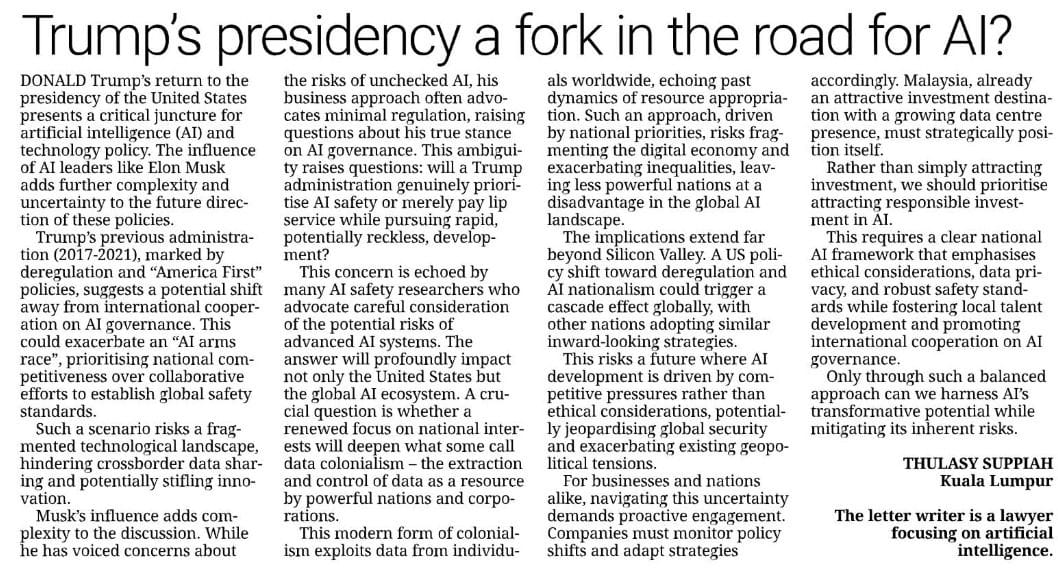
Donald Trump’s return to the presidency presents a critical juncture for AI and technology policy. The influence of AI leaders like Elon Musk adds further complexity and uncertainty to the future direction of these policies.
Trump’s previous administration, marked by deregulation and “America First” policies, suggests a potential shift away from international cooperation on AI governance. This could exacerbate an “AI arms race,” prioritizing national competitiveness over collaborative efforts to establish global safety standards.[1] Such a scenario risks a fragmented technological landscape, hindering cross-border data sharing and potentially stifling innovation.
Elon Musk’s influence adds complexity to the discussion. While he has voiced concerns about the risks of unchecked AI [2], his business approach often advocates for minimal regulation, [3] raising questions about his true stance on AI governance. This ambiguity raises questions: will a Trump administration genuinely prioritize AI safety or merely pay lip service while pursuing rapid, potentially reckless, development? This concern is echoed by many AI safety researchers who advocate for careful consideration of the potential risks of advanced AI systems.[4] The answer will profoundly impact not only the US but the global AI ecosystem. A crucial question is whether a renewed focus on national interests will deepen what some call data colonialism—the extraction and control of data as a resource by powerful nations and corporations.
This modern form of colonialism exploits data from individuals worldwide, echoing past dynamics of resource appropriation. Such an approach, driven by national priorities, risks fragmenting the digital economy and exacerbating inequalities, leaving less powerful nations at a disadvantage in the global AI landscape.[5] The implications extend far beyond Silicon Valley. A US policy shift toward deregulation and AI nationalism could trigger a cascade effect globally, with other nations adopting similar inward-looking strategies. This risks a future where AI development is driven by competitive pressures rather than ethical considerations, potentially jeopardizing global security and exacerbating existing geopolitical tensions.
For businesses and nations alike, navigating this uncertainty demands proactive engagement. Companies must monitor policy shifts and adapt strategies accordingly. Malaysia, already an attractive investment destination with a growing data centre presence, must strategically position itself. Rather than simply attracting investment, we should prioritize attracting responsible investment in AI. This requires a clear national AI framework that emphasizes ethical considerations, data privacy, and robust safety standards while fostering local talent development and promoting international cooperation on AI governance. Only through such a balanced approach can we harness AI’s transformative potential while mitigating its inherent risks.
© 2025 Suppiah & Partners. All rights reserved. The contents of this newsletter are intended for informational purposes only and do not constitute legal advice.
More Featured Articles






REACH US
SUPPIAH & PARTNERS
(Formerly Law Office of Suppiah)
NAVIGATION
ARTICLES
- COPYRIGHT © 2026 SUPPIAH & PARTNERS ALL RIGHTS RESERVED
- HTML SITEMAP
- PRIVACY POLICY