[Feature Article] The Star Newspaper: High Stakes Game in Global Chip Industry

High Stakes Game in Global Chip Industry

Published by The Star on 21 Jan 2025

by Thulasy Suppiah, Managing Partner

Donald Trump’s return to power throws a wildcard into the already volatile global chip war. For Malaysia, a nation deeply embedded in the semiconductor industry, this isn’t just about international trade; it’s about safeguarding our economic future.

Trump’s “America First” rhetoric and escalating tensions with China point to an intensified push for decoupling and reshoring of chip production. While these developments pose challenges, they also present unique opportunities for Malaysia. As global tech giants diversify their supply chains away from China, Malaysia has a chance to position itself not just as a manufacturing hub, but as a strategic partner.

Seizing this opportunity demands more than opening our doors to foreign investment. The National Semiconductor Strategy is a good foundation, but we must prioritize moving up the value chain. Investing in advanced packaging, testing, and even chip design will give us the competitive edge to attract high-value projects.

At the same time, Malaysia needs to tread carefully in its geopolitical strategy. Maintaining strong relationships with both the US and China is essential. Overreliance on one side could leave us exposed in this high-stakes game. Balancing diplomacy with strategic economic policies will be key. Adding to the complexity are the recent last-minute restrictions on AI chip exports imposed by the Biden administration before leaving office. These restrictions, implemented just days before Trump’s inauguration, introduce a tiered licensing system that effectively limits the export of advanced AI chips to certain countries, including China. This move, heavily criticized by industry giants, was seen as a parting shot in the escalating US-China tech war. Some argue that these restrictions, drafted without significant industry input, could backfire, harming US competitiveness and ceding ground to rivals. Will Trump maintain these curbs, tighten them, or scrap them altogether? The uncertainty creates a challenging environment for countries like Malaysia, deeply embedded in the global semiconductor supply chain. Malaysia must prepare for all scenarios by fostering a robust and adaptable semiconductor ecosystem.

This isn’t just a battle over chips; it’s a fight for data dominance. As Malaysia aspires to become a regional data centre hub, aligning this ambition with a strong cybersecurity framework will be critical to protect our national interests.

Trump’s presidency will undoubtedly reshape the global tech landscape. Malaysia has the potential to emerge stronger, but we must be proactive, strategic, and prepared to navigate the uncertainties ahead. The chip war is a gamble, and Malaysia must play its cards wisely.

© 2025 Suppiah & Partners. All rights reserved. The contents of this newsletter are intended for informational purposes only and do not constitute legal advice.


More Featured Articles

[Feature Article] The Star Newspaper: Cyber Threats to Aviation Industry

Cyber Threats to Aviation Industry

Published by The Star on 6 Jan 2025

by Thulasy Suppiah, Managing Partner

The recent cyberattack on Japan Airlines, while quickly resolved, serves as a stark reminder of the increasing vulnerability of the aviation sector. While the airline claims no passenger data was leaked, the disruption highlights a growing threat: our skies are no longer just vulnerable to weather patterns, but also to digital storms.

The aviation industry is a prime target for cybercriminals. From ticketing systems to air traffic control, our planes and airports rely on a complex web of interconnected IT systems. A successful attack can cripple operations, costing airlines millions in lost revenue and leaving passengers stranded. Think holiday travel chaos, but sparking a social media frenzy.

But the financial fallout is just the tip of the iceberg. Data breaches can expose sensitive passenger information, and the potential for a cyberattack to compromise flight control systems is a chilling thought. Imagine a hacker taking control of a plane mid-flight – it’s a scenario straight out of a Hollywood thriller, but the threat is real.

Cyberattacks are becoming increasingly sophisticated. Ransomware, DDoS attacks, and the exploitation of third-party software vulnerabilities, like the CrowdStrike outage in 2024, are just some of the tactics employed. Remember that global IT meltdown that grounded planes, froze bank accounts, and silenced news outlets? That’s the interconnected world we live in, and aviation is right in the crosshairs.

The increasing use of AI and cloud technologies in aviation, while promising greater efficiency, also expands the attack surface. More connected systems mean more entry points for hackers. And it’s not just cybercriminals we need to worry about; nation-state actors and hacktivists also have the aviation industry in their sights.

So, what’s being done to protect our skies? In Malaysia, the Malaysian Aviation Commission (MAVCOM) plays a key role in ensuring aviation security, working with other agencies and stakeholders to improve cybersecurity measures. CyberSecurity Malaysia also plays a crucial role in effectively implementing national cybersecurity strategies and providing expertise to various sectors, including aviation. But is it enough? We need a robust, multi-layered approach that combines strong regulations, cutting-edge security technologies, and constant vigilance. We also need to invest in training and education to ensure our aviation professionals are equipped to handle these evolving threats. The question isn’t if another cyberattack will occur, but when. Let’s hope we’re ready when it does.

© 2025 Suppiah & Partners. All rights reserved. The contents of this newsletter are intended for informational purposes only and do not constitute legal advice.

More Featured Articles

[Feature Article] Levelling Up Malaysia’s Data Center Potential

Levelling Up Malaysia's Data Center Potential

Published by The Sun on 16 Dec 2024

by Thulasy Suppiah, Managing Partner

Southeast Asia is a data centre goldmine, and Malaysia is poised to seize a significant share. But to truly compete with regional rivals like Singapore, we need to refine our strategies and double down on our strengths.

Singapore’s established Green Data Centre Standard has set a high bar for the region, attracting environmentally conscious companies with its clear focus on energy efficiency. While Malaysia is developing its own Power Usage Effectiveness guidelines, we have a unique opportunity to leapfrog ahead by incorporating cutting-edge sustainability practices from the outset. This could position Malaysia as a leader in green data centre development.

On cybersecurity, both nations recognize the critical importance of protecting sensitive data. Malaysia’s newly enacted Cyber Security Act 2024 provides a foundation, but its effectiveness remains to be seen. Given its recent implementation, it’s crucial to ensure robust enforcement and proactive engagement with the industry. This will not only address potential vulnerabilities but also build confidence that Malaysia is committed to creating a secure and trustworthy environment for data centre operations. A clear demonstration of this commitment will be essential for attracting global players and investors in the data centre sector.

Both countries require environmental impact assessments for large-scale data centres. Malaysia’s EIA process, however, is based on legislation from 1974 – long before the data centre boom. While this provides a general framework, we need to develop more tailored assessment criteria that address the specific environmental challenges posed by data centres, including energy consumption, water usage, and waste management.

Singapore’s Call-for-Application scheme streamlines planning and aligns growth with sustainability goals. Malaysia can create an equally effective system, tailored to our unique context, providing clarity and efficiency in the development process to attract greater investment.

Malaysia has all the ingredients for success in the data centre arena: strategic location, robust infrastructure, and a growing tech talent pool. By strategically refining our regulatory landscape and showcasing our commitment to sustainability and security, we can unlock our full potential and become a global data centre leader.

© 2025 Suppiah & Partners. All rights reserved. The contents of this newsletter are intended for informational purposes only and do not constitute legal advice.

More Featured Articles

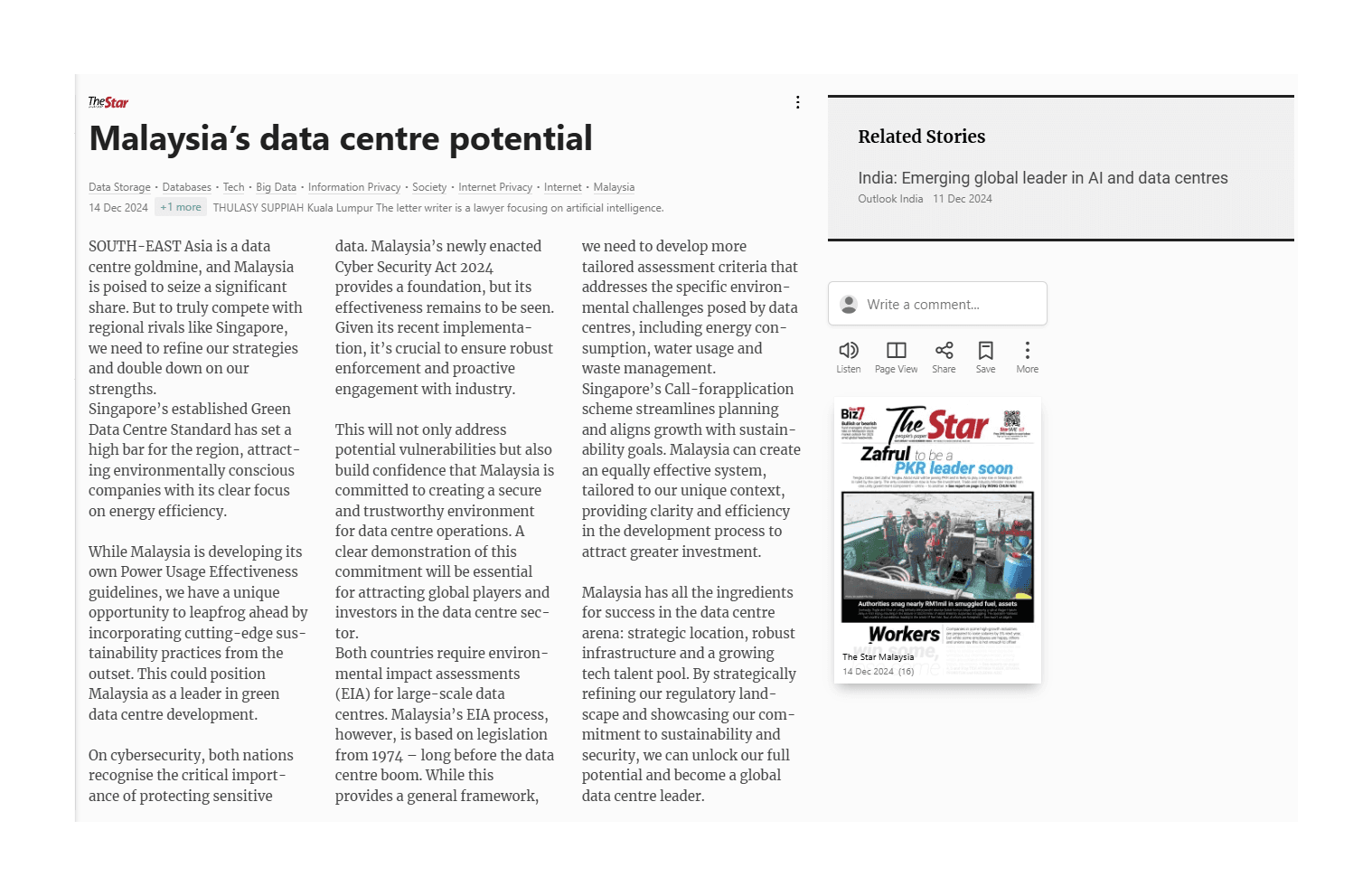
[Feature Article] The Star Newspaper: Malaysia’s Data Centre Potential

Malaysia’s Data Centre Potential

Published by The Star on 14 Dec 2024

by Thulasy Suppiah, Managing Partner

Southeast Asia is a data centre goldmine, and Malaysia is poised to seize a significant share. But to truly compete with regional rivals like Singapore, we need to refine our strategies and double down on our strengths.

Singapore’s established Green Data Centre Standard has set a high bar for the region, attracting environmentally conscious companies with its clear focus on energy efficiency. While Malaysia is developing its own Power Usage Effectiveness guidelines, we have a unique opportunity to leapfrog ahead by incorporating cutting-edge sustainability practices from the outset. This could position Malaysia as a leader in green data centre development.

On cybersecurity, both nations recognize the critical importance of protecting sensitive data. Malaysia’s newly enacted Cyber Security Act 2024 provides a foundation, but its effectiveness remains to be seen. Given its recent implementation, it’s crucial to ensure robust enforcement and proactive engagement with the industry. This will not only address potential vulnerabilities but also build confidence that Malaysia is committed to creating a secure and trustworthy environment for data centre operations. A clear demonstration of this commitment will be essential for attracting global players and investors in the data centre sector.

Both countries require environmental impact assessments for large-scale data centres. Malaysia’s EIA process, however, is based on legislation from 1974 – long before the data centre boom. While this provides a general framework, we need to develop more tailored assessment criteria that address the specific environmental challenges posed by data centres, including energy consumption, water usage, and waste management.

Singapore’s Call-for-Application scheme streamlines planning and aligns growth with sustainability goals. Malaysia can create an equally effective system, tailored to our unique context, providing clarity and efficiency in the development process to attract greater investment.

Malaysia has all the ingredients for success in the data centre arena: strategic location, robust infrastructure, and a growing tech talent pool. By strategically refining our regulatory landscape and showcasing our commitment to sustainability and security, we can unlock our full potential and become a global data centre leader.

© 2025 Suppiah & Partners. All rights reserved. The contents of this newsletter are intended for informational purposes only and do not constitute legal advice.

More Featured Articles

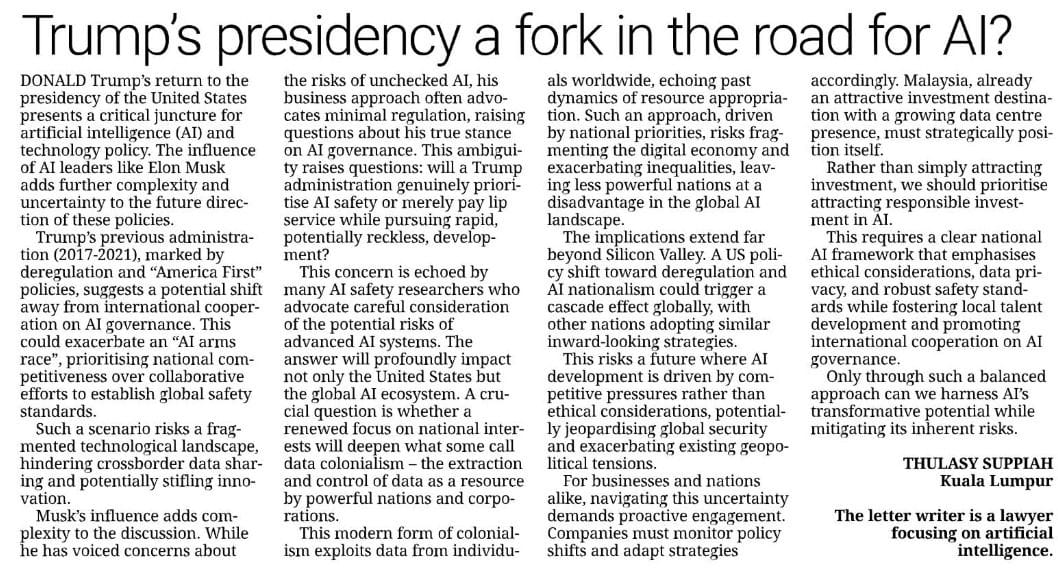
[Feature Article] The Star Newspaper: Trump’s presidency a fork in the road for Al?

Trump's Presidency a Fork in the Road for Al?

Published by The Star on 14 Nov 2024

by Thulasy Suppiah, Managing Partner

Donald Trump’s return to the presidency presents a critical juncture for AI and technology policy. The influence of AI leaders like Elon Musk adds further complexity and uncertainty to the future direction of these policies.

Trump’s previous administration, marked by deregulation and “America First” policies, suggests a potential shift away from international cooperation on AI governance. This could exacerbate an “AI arms race,” prioritizing national competitiveness over collaborative efforts to establish global safety standards.[1] Such a scenario risks a fragmented technological landscape, hindering cross-border data sharing and potentially stifling innovation.

Elon Musk’s influence adds complexity to the discussion. While he has voiced concerns about the risks of unchecked AI [2], his business approach often advocates for minimal regulation, [3] raising questions about his true stance on AI governance. This ambiguity raises questions: will a Trump administration genuinely prioritize AI safety or merely pay lip service while pursuing rapid, potentially reckless, development? This concern is echoed by many AI safety researchers who advocate for careful consideration of the potential risks of advanced AI systems.[4] The answer will profoundly impact not only the US but the global AI ecosystem. A crucial question is whether a renewed focus on national interests will deepen what some call data colonialism—the extraction and control of data as a resource by powerful nations and corporations.

This modern form of colonialism exploits data from individuals worldwide, echoing past dynamics of resource appropriation. Such an approach, driven by national priorities, risks fragmenting the digital economy and exacerbating inequalities, leaving less powerful nations at a disadvantage in the global AI landscape.[5] The implications extend far beyond Silicon Valley. A US policy shift toward deregulation and AI nationalism could trigger a cascade effect globally, with other nations adopting similar inward-looking strategies. This risks a future where AI development is driven by competitive pressures rather than ethical considerations, potentially jeopardizing global security and exacerbating existing geopolitical tensions.

For businesses and nations alike, navigating this uncertainty demands proactive engagement. Companies must monitor policy shifts and adapt strategies accordingly. Malaysia, already an attractive investment destination with a growing data centre presence, must strategically position itself. Rather than simply attracting investment, we should prioritize attracting responsible investment in AI. This requires a clear national AI framework that emphasizes ethical considerations, data privacy, and robust safety standards while fostering local talent development and promoting international cooperation on AI governance. Only through such a balanced approach can we harness AI’s transformative potential while mitigating its inherent risks.

© 2025 Suppiah & Partners. All rights reserved. The contents of this newsletter are intended for informational purposes only and do not constitute legal advice.

More Featured Articles