
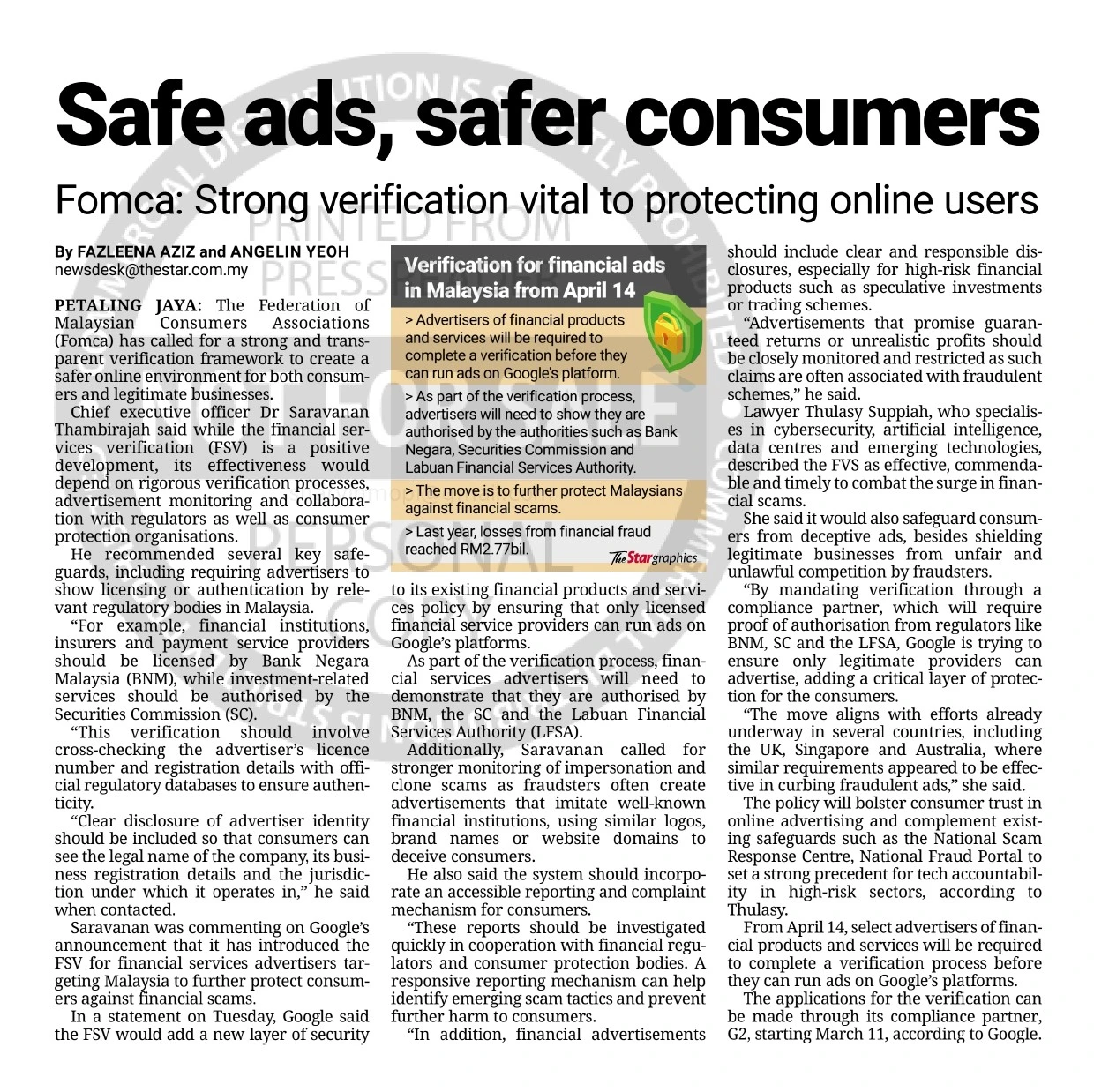

[Media Features] The Star: Safe Ads, Safer Consumers
Quoted by The Star on 13 Mar 2025
by Thulasy Suppiah, Managing Partner
© 2025 Suppiah & Partners. All rights reserved. The contents of this newsletter are intended for informational purposes only and do not constitute legal advice.

Published by The Star on 04 Mar 2026
The recent declaration by the government that overseas tech executives could face legal action under the new online safety law has predictably sparked dramatic headlines. The imagery of tech billionaires answering to a Malaysian court is certainly compelling political theatre. However, this spectacle risks obscuring the profound structural realignment actually taking place within our digital borders.
Malaysia is not acting as a rogue regulator; we are merely waking up to a hardened global reality. For too long, multinational platforms operated under a doctrine of digital exceptionalism, treating foreign jurisdictions as lucrative revenue streams free from sovereign oversight.
But with the introduction of frameworks like the UK’s Online Safety Act, and the watershed arrest of Telegram’s CEO in France, the illusion of Silicon Valley immunity has permanently shattered. We are witnessing the global collision between the “move fast and break things” ethos and the sovereign duty of nations to protect their citizens.
Beyond the headline-grabbing prospect of charging foreign executives, the operational spine of the Online Safety Act 2025 (ONSA) is far more pragmatic: the mandatory appointment of a local representative.
This provision bridges a critical jurisdictional gap. Where regulators previously grappled with the friction of enforcing domestic laws against entities domiciled abroad, a local presence ensures that accountability is no longer remote or theoretical, but actionable within our own courts.
Yet, the ultimate success of this framework hinges on a critical legal caveat. Executives can avoid liability if they demonstrate the offence occurred without their consent and that they took “reasonable steps” to prevent it. How our courts and regulators define this threshold will be the defining legal battleground of the next decade.
This is where the intersection of law and generative AI becomes inherently perilous. Consider the controversy where X (formerly Twitter) permitted its Grok AI to generate and manipulate user images without robust, market-ready guardrails.
If a platform deliberately designs and deploys a tool that inherently bypasses consent and facilitates the creation of explicit material, can its leadership legitimately claim they took “reasonable steps” to protect the public?
Relying on after-the-fact user reporting for foreseeable harms is no longer an acceptable defence; it is an abdication of duty.
For global tech entities, this legislation should not be viewed as a death knell for innovation, but as a demand for regulatory certainty. To maintain market access in Malaysia, platforms must pivot from relying on flawed, reactive content moderation to a proactive “safety by design” framework.
Just as we require safety certifications for physical infrastructure, we must now demand Algorithmic Impact Assessments from our digital landlords. The message is unequivocal: the future belongs to digital innovation, but that innovation requires a local license to operate.
© 2025 Suppiah & Partners. All rights reserved. The contents of this newsletter are intended for informational purposes only and do not constitute legal advice.

Published by The Star and New Straits Times on 07 Feb 2026
As a society, we are currently grappling with a profound sense of violation. Recent global reports surrounding certain generative AI platforms, highlighting their capacity to generate non-consensual, sexually explicit deepfakes of women and children, have rightly sparked widespread outrage. It forces us to confront a reality many find difficult to process: the troubling potential for automated exploitation.
The strong global reaction to these non-consensual deepfakes—a clear violation of human dignity and online safety—stems from a collective understanding that our image, our body, and our identity are intrinsically our own.
Yet, almost simultaneously, we witness a jarring paradox. While we recoil from the potential theft and misuse of our digital identity, we often voluntarily surrender intimate details for the sake of a viral trend.
This is evident in phenomena like recent AI caricature trends, where users upload selfies and provide detailed personal prompts—or simply instruct the AI to generate portraits based on ‘everything it knows.’ Whether actively describing their jobs and home environments or passively granting permission to scour their cumulative chat history, the result is the same. Users are allowing the AI to aggregate scattered data points into a cohesive, high-resolution psychographic profile linked to their biometric data.
This cognitive dissonance is alarming. On one hand, there is a global call for stricter measures against AI misuse. On the other, we treat our sensitive personal data as currency to purchase a fleeting moment of social media engagement.
From a legal and data privacy perspective, this normalization of “data surrender” carries inherent risks. When individuals participate in these trends, they are not merely “playing” with AI; they are actively training it. Algorithms learn to recognise faces, understand contexts, and map lives with increasing precision. Every piece of data fed into these models contributes to a digital profile that renders individuals increasingly identifiable and vulnerable to targeting.
The implications for the vulnerable—particularly children—are profound. While children cannot legally provide consent, the long-term privacy implications of their digital footprints, established by well-meaning adults uploading their images for AI-generated content, are significant. Such actions contribute to an ever-expanding digital dossier for a child, established without their future agency or understanding.
This is not to suggest that technology is inherently malicious, nor that progress should be halted. Innovation offers immense benefits and is crucial for societal advancement. However, it is imperative to critically assess the terms of our engagement with these powerful tools.
We cannot effectively advocate for robust protections against the non-consensual weaponization of AI if we simultaneously cultivate a culture of uncritical over-sharing. Responsible digital citizenship requires a clear understanding that privacy is not merely a passive right to be enforced, but an active discipline that individuals must exercise.
To foster a digital ecosystem that genuinely respects human dignity and drives
responsible innovation, we must shift our collective mindset. We must recognise that in the age of AI, our identity—our face, our history, our context—is our most valuable asset. Protecting it demands not just robust legal frameworks against exploitation, but also a conscious cultivation of data hygiene and digital discernment.
© 2025 Suppiah & Partners. All rights reserved. The contents of this newsletter are intended for informational purposes only and do not constitute legal advice.

Published by The Star on 29 Jan 2026
PETALING JAYA: The Artificial Intelligence (AI) Governance Bill is a necessary and timely step toward responsible AI deployment in Malaysia, which demonstrates that clearer laws give confidence and certainty to investors, developers, as more users adopt AI in their daily lives, say experts on the matter.
Lawyer Thulasy Suppiah, who specialises in cybersecurity, AI, data centres and emerging technologies, said that clear rules can help reduce regulatory ambiguity, allowing companies to design, deploy and invest in AI without fear of sudden bans, inconsistent enforcement or reputational risk.
“A legal framework signals that Malaysia welcomes AI driven investment responsibly, with accountability across the AI life- cycle. Without clear rules, trust erodes and trust is essential for sustainable AI growth and foreign investment.
“It ensures innovation grows with safeguards, not at the expense of women, children and vulnerable groups who are often the first to be victims of misuse of AI.
“Embedding accountability across the AI lifecycle also strengthens protection against misuse, including exploitation, harassment and deception,” she said in response to Malaysia’s first AI Governance Bill.
Asked about the challenges in coordinating with other agencies and laws on AI and threats such as deepfakes and AI-enabled scams, Thulasy said AI risks cut across multiple domains, including data protection, cybersecurity, content safety, fraud and consumer protection, requiring close coordination.
As such, she said aligning enforcement while avoiding overlap or gaps between agencies is complex, but necessary to ensure real-world protection, especially for women and children.
“The challenge is balancing speed, clarity, and proportionality without stifling legitimate innovation,” she said.
Cybersecurity expert Fong Choong Fook said the Bill should include risk classifications when it comes to AI systems alongside mandating impact assessments for high-risk AI.
Independent audits and conformity assessments are needed to ensure compliance alongside constant monitoring.
Fong said the Bill should enhance coordination efforts with existing enforcement regulations.
“It should supplement instead of duplicate. The key is ensuring accountability across the entire AI lifecycle.”
Malaysia, he said, should adopt a hybrid model when it comes to regulating AI.
This would comprise the formation of a central AI authority to set standards and coordinate oversight while sector regulators, such as those in the finance and telecommunication industries, carry out enforcement through their own domains.
“This provides consistency without losing on expertise,” he said. On deepfake content, Fong said watermarks must be made mandatory for high-risk and high reach content.
“We also need stronger platform takedown obligations, where platforms must comply with local regulations and will take swift action to remove non-compliant content, upon request” he said.
Universiti Putra Malaysia (UPM) AI specialist Azree Nazri said the Bill should mandate security-by-design standards to mitigate risks such as automated scams, system abuse and AI-enabled attacks.
“High-risk AI systems should undergo mandatory adversarial testing, strict model access controls and continuous monitoring with incident reporting,” he said.
On AI-enabled scams. Azree said telecom style deterrents could form part of new measures to curb this.
He also stressed avoiding regulatory overlap to ensure aligned enforcement, prevent duplicate investigations, and deliver consistent oversight.
© 2025 Suppiah & Partners. All rights reserved. The contents of this newsletter are intended for informational purposes only and do not constitute legal advice.

Published by The Star on 15 Jan 2026
by Thulasy Suppiah, Managing Partner
THE decision by the Malaysian Communications and Multimedia Commission (MCMC) to block access to the AI chatbot Grok is a decisive, albeit reactive, measure. This action, taken to prevent content that creates liability under Malaysian laws including Section 233 of the Communications and Multimedia Act 1998, serves as a necessary firebreak against the unchecked proliferation of non-consensual, sexually explicit deepfakes.
However, this incident also underscores the timeliness of the Online Safety Act 2025 (ONSA), which came into force on Jan 1. ONSA fundamentally reshapes the liability landscape by designating social media platforms as Licensed Service Providers. It explicitly classifies child sexual abuse material and financial fraud as ‘priority harmful content’ which must be blocked as swiftly as possible.
While the ban addresses the immediate symptom, we must recognise that the threat is no longer theoretical or confined to foreign platforms. It is local, and it is already in our classrooms.
The case in Johor Bahru last year, where a teenager allegedly used AI to create explicit deepfake images of his schoolmates, was an early warning. More recently, in December 2025, a school in Muar expelled three students for similar conduct, where manipulated images of female classmates were circulated online.
These incidents demonstrate that the technology is accessible, easy to use, and weaponisable by anyone. This highlights the limitations of reactive bans. Even if we block commercial platforms like Grok, open-source models remain accessible to the tech-savvy.
Therefore, for the legal and business fraternity, the Grok controversy is a case study in product liability.
The developers of Grok deployed a tool with known vulnerabilities—specifically, the capability to “digitally undress” subjects, including minors—without adequate safeguards. From a legal standpoint, relying on after-the-fact reporting for foreseeable harms is no longer an acceptable defense. We are witnessing the collision between the Silicon Valley ethos of “move fast and break things” and the sovereign duty of nations to protect human dignity.
Critics often argue that strict regulation will stifle innovation and deter foreign direct investment (FDI). This is a false dichotomy.
High-value, institutional investors and serious technology majors do not seek a regulatory “Wild West.” They seek regulatory certainty. An ecosystem where AI tools can be weaponized to generate pornography or harass citizens is inherently unstable and fraught with legal risk. By enforcing clear standards, Malaysia is not repelling investment; it is filtering out high-risk actors and creating a safe harbour for responsible AI development.
Thus, we must pivot from reactive bans to a proactive “Safety by Design” framework.
Any AI entity seeking market access in Malaysia should be compelled to demonstrate that safety guardrails are intrinsic to the code, not an afterthought. Just as we require safety certifications for imported vehicles or pharmaceuticals, we must require Algorithmic Impact Assessments for generative AI tools. If a platform cannot technically guarantee that it will not generate child sexual abuse material (CSAM) upon a simple prompt, it is not “market-ready.”
Our legal response moving forward must be two-pronged.
First, on the supply side, we must enforce corporate accountability. Tech giants can no longer claim neutrality; if their product design facilitates abuse, they must share the liability.
Second, on the demand side, we need urgent digital legal literacy. The public, especially the youth, must understand that using AI to generate non-consensual explicit imagery is not a “prank” or a technological experiment. It is a potential criminal offence with severe consequences under our Penal Code and the Sexual Offences Against Children Act.
The Grok ban is a necessary firebreak, but it is not a permanent solution. The future belongs to AI, but sustainable innovation requires a social license to operate. Malaysia has the opportunity to lead ASEAN not just in digital adoption, but in crafting a governance framework where technology respects the law, and the law understands technology.
© 2025 Suppiah & Partners. All rights reserved. The contents of this newsletter are intended for informational purposes only and do not constitute legal advice.

Published by The Star on 4 Dec 2025
by Thulasy Suppiah, Managing Partner
The recent announcement by HP Inc. to cut thousands of jobs globally as part of a pivot towards artificial intelligence is a stark, flashing warning light. It follows similar moves by tech giants like Amazon and Microsoft. This is no longer a distant theoretical disruption; it is a structural realignment of the global workforce happening in real-time. The question we must urgently ask is: Is Malaysia’s workforce prepared to pivot, or will we be left behind?
Locally, the data paints a sobering picture. According to TalentCorp’s 2024 Impact Study, approximately 620,000 jobs—18% of the total workforce in core sectors—are expected to be highly impacted by AI, digitalisation, and the green economy within the next three to five years. When we include medium-impact roles, that figure swells to 1.8 million employees. That is 53% of our workforce facing significant disruption.
While the government has measures in place, a critical gap remains in on-the-ground awareness. Are Malaysian companies thoroughly assessing which roles within their structures are at risk? More importantly, are employees aware that their daily tasks might soon be automated?
This is no longer just about competitiveness; it is about survivability. The speed of AI evolution is relentless. Take the creative and media industries, for example. With the advent of AI video generation tools like Google’s Gemini Veo and Grok’s Imagine, high-quality content can be produced in seconds. For our local media professionals, designers, and content creators, the question isn’t just “can I do it better?” but “is my role still necessary in its current form?”
Productivity is the promise of AI, but productivity without ethics is a liability. We witnessed this grim reality in April, when a teenager in Kulai was arrested for allegedly using AI to create deepfake pornography of schoolmates. This incident raises a terrifying question about our future talent pipeline: as these young digital natives transition into the workforce, do they possess the moral compass to use these powerful tools responsibly? A workforce that is technically literate but ethically bankrupt is a danger to any organisation and the community it serves.
Upskilling is no longer a corporate buzzword for talent retention; it is a necessity for future-proofing our economy. As indicated by the TalentCorp study, skills transferability will become the norm. The ability to pivot—to move from a role that AI displaces to a role that AI enhances—will be the defining trait of the successful Malaysian worker.
We cannot afford to be complacent. The layoffs at HP and other giants are not just business news; they are a preview of the new normal. AI is not waiting for us to be ready. Companies must move beyond basic digital literacy to deep AI literacy, auditing their workflows and preparing their human talent to work alongside machines. Employees must accept that the job they have today may not exist, or will look radically different, in three years.
The window for adaptation is closing fast. We must act with urgency to ensure our workforce is resilient, ethical, and adaptable enough to survive the AI wave, rather than be swept away by it.
© 2025 Suppiah & Partners. All rights reserved. The contents of this newsletter are intended for informational purposes only and do not constitute legal advice.

By Thulasy Suppiah, Managing Partner of Suppiah & Partners &
Adjunct Professor Murugason R. Thangarathnam, Chief Executive Officer of Novem CS

Malaysia has been resolutely updating its digital and technology regulations with forward-looking policies. They signify the nation’s aspirations to strengthen areas such as online safety, cybersecurity and data protection and governance, and to address the complex and global nature of the digital environment. Given the severity of potential harms, self-regulation by tech companies is insufficient to protect individuals and maintain trust. By strengthening data governance and establishing frameworks like the National Guidelines on AI Governance & Ethics, Malaysia is actively working to build a trusted and secure digital ecosystem for both consumers and businesses.
Several important developments have transpired in Malaysia’s digital regulatory landscape especially in the last two years, indicative of the government’s strong commitment to cultivate a safe digital ecosystem. For businesses operating or looking to operate in Malaysia, especially businesses in the telecommunications, technology, information security, or other infrastructure sectors, let us hold your hands and take you through these important developments.
First, the Ministry of Communications and Digital was separated into two ministries – the Ministry of Digital and the Ministry of Communications. The separation in 2023, clarified mandates for communications regulations versus digital governance. The Ministry of Digital now oversees the Personal Data Protection Department (PDPD) and, through its Minister Gobind Singh Deo, has proposed a Data Commission to execute the Data Sharing Act.

Then in August 2024, The Cyber Security Act 2024 (Act 854) came into force. This is a landmark piece of legislation in Malaysia aimed at strengthening the nation’s cyber defences and resilience against evolving cyber threats.
As of June 2025, major amendments to the Personal Data Protection Act (PDPA) took effect. The amendments include new requirements for mandatory data breach notification, the right to data portability, and the appointment of a Data Protection Officer (DPO). Businesses acting as data processors now face direct security obligations, while maximum fines for non-compliance have more than tripled to RM 1,000,000.
Malaysia was the first ASEAN Member State to enact a comprehensive data protection legislation in 2010 but the recent amendments align Malaysia’s data protection standards more closely with influential international frameworks like the EU’s GDPR (General Data Protection Regulation).
This paper aims to breakdown the key components and implications of the Cyber Security Act 2024 (CSA), vital to protect our digital environment and earn the trust of all Malaysians.


Key provisions and scope
The CSA 2024 establishes Malaysia’s digital defence framework by certifying the National Cyber Security Committee (NACSA) as the national lead agency with legislative power to ensure the effective implementation of this Act. It outlines the duties and powers of the Chief Executive of NACSA, as well as the functions and duties of the National Critical Information Infrastructure (NCII) sector leads and NCII entities.
The NCII is essentially the central nervous system of a country—the most vital computer systems, networks, and data that keep essential services like banking, electricity, telecommunications, and agriculture, running – the stuff that absolutely must work for society to function normally. It is the information and the digital technology that is so important to a nation that if it were to be shut down, destroyed, or seriously damaged, it would have a devastating impact on national security, the economy, or public health and safety.
The CSA sets the mandatory cybersecurity standards for NCII operators, and creates a licensing regime for cybersecurity service providers to regulate incident response and practice across the country. The Act also has extra-territorial application, to the extent that it imposes requirements for any NCII that “is wholly or partly in Malaysia”.
Objectives and regulatory framework
The primary goal of the CSA is to ensure a secure, trusted, and resilient cyberspace in Malaysia and to safeguard critical national functions. Its key objectives can be broken down as such:
The CSA identifies the 11 sectors designated as NCII sectors, and mandates strict compliance for organisations operating within them.

These sectors, listed below, are now legally required to enhance their cyber resilience or face penalties:
To manage the 11 NCII sectors, the Act allows the Minister to appoint multiple NCII Leads per sector for flexibility. All appointed Leads will be publicly listed on the NACSA website.
Enforcement mechanisms and penalties
The Act applies to licensed cybersecurity service providers (CSSPs) that are designated as NCII entities and the penalties are substantial, including large fines and long imprisonment terms for noncompliance.
The key mechanisms used to ensure compliance and investigate violations are:
Duty to Provide Information Relating to NCII: NCII Entities must provide all requested NCII information to the Sector Lead, automatically report the acquisition of any new NCII, and notify the Lead of any material changes to the NCII’s design, configuration, security, or operation. Failure to comply with any of these duties carries a penalty of up to RM100,000 fine, two years imprisonment, or both.

Duty to Implement the Code of Practice: NCII Entities must implement the measures, standards, and processes specified in the Code of Practice. However, they may use alternative measures if they prove an equal or higher level of NCII protection. Failure to comply can result in a fine up to RM500,000, imprisonment up to ten years, or both.
Duty to Conduct Cybersecurity Risk Assessment and Audit: NCII Entities must conduct mandatory cybersecurity risk assessments (at least annually) and audits (at least once every two years). The results must be submitted to the Chief Executive. Failure to conduct these assessments or submit the reports can lead to a fine of up to RM200,000 or imprisonment for a term not exceeding three years, or both.
Duty to Notify Cyber Security Incidents: NCII Entities have a strict legal duty to immediately report cyber security incidents to the Chief Executive and their Sector Lead (with a detailed report required within a short timeframe, typically 6 hours for initial details). The initial notification should describe the cybersecurity incident, its severity, and the method of discovery. A full report must be submitted within 14 days, including details such as the number of hosts affected, information on the cybersecurity threat actor, and the incident’s impact. Noncompliance invites penalties of up RM500,000 or imprisonment for a term not exceeding ten years, or both.


Cybersecurity Incident Response Directive: Upon receiving a notification of a cybersecurity incident from an NCII Entity, the Chief Executive will investigate and may issue a directive on necessary measures to respond to or recover from the incident. The term “directive” underscores the importance of compliance. Failure to adhere to these directives may result in a fine of up to RM200,000 ringgit or imprisonment for a term not exceeding three years, or both.
Licensing: The CSA establishes a licensing regime for individuals and entities providing prescribed cybersecurity services. There are currently two categories of prescribed cyber security services: (i) managed security operation centre monitoring services; and (ii) penetration testing services. To obtain a licence, an application must be made to the Chief Executive with a prescribed fee and required documents (including qualifications and ID). Applicants must meet prerequisites set by the Chief Executive and have no convictions for fraud, dishonesty, or moral turpitude. The Chief Executive can approve the licence (with variable conditions) or refuse it (stating the grounds). Operating without a required licence is an offence. Providing or advertising services without a licence will incur a fine of up to RM500,000 or imprisonment up to ten years, or both. A fine up to RM200,000 or imprisonment up to 3 years, or both will be imposed for a breach of license conditions.
A broad extra-territorial scope: The CSA’s authority extends beyond Malaysia’s physical borders. The extraterritorial reach is particularly important for foreign companies that operate services or infrastructure in Malaysia, especially those designated as NCII Entities. If a foreign multinational company’s Malaysian subsidiary owns or operates NCII in Malaysia, the foreign parent company and its personnel can potentially face legal consequences under the CSA for offences or non-compliance related to that Malaysian NCII. Foreign-based CSSPs whose services (like managed security or penetration testing) affect NCII within Malaysia must also comply with the Act’s licensing requirements and standards.
Malaysia’s Cyber Security Act 2024 (CSA) is fundamentally like Singapore’s Cybersecurity Act 2018 (SG CA) – both are national laws designed to protect critical digital infrastructure. Both Acts establish a dedicated national agency with primary authority: the National Cyber Security Agency (NACSA) in Malaysia and the Cyber Security Agency in Singapore
While both Acts are primarily designed to protect infrastructure with critical information that is the NCII in Malaysia and the Critical Information Infrastructure (CII) in Singapore, the main differences lie in the severity of penalties, scope of regulation, and specific reporting requirements.
Malaysia’s penalties for non-compliance are generally harsher. For instance, our maximum fine is up to RM500, 000 and/or imprisonment up to 10 years for serious noncompliance (e.g., failure to report an incident or implement the Code of Practice). Singapore’s SG CA 2018 was less severe but its 2024 amendments have increased penalties, allowing for civil penalties up to S$500,000 (RM1,626,160) or 10 per cent of annual turnover for the entity, whichever is greater. However, the maximum penalty for certain core breaches (like failing an audit) in Singapore, is generally lower than Malaysia’s for similar offences.
Malaysia’s CSA also primarily focuses on criminal penalties (fines and/or imprisonment) for non-compliance while Singapore employs a flexible mix of civil and criminal penalties. The Cybersecurity Agency can pursue civil penalties instead of criminal ones for certain breaches.

In terms of the scope of incidence reporting, the CSA primarily focuses on incidents directly affecting the NCII entity itself. Singapore’s SG CA has a broader scope following its 2024 amendments, requiring CII owners to report incidents involving their third-party vendors and supply chains.
Malaysia’s CSA mainly focuses on regulating NCII Entities and CSSPs. The 2024 amendments to the SG CA expanded its regulatory scope to include new categories like: Foundational Digital Infrastructure (FDI) providers (e.g., cloud services and data centres, even if they do not directly own a CII), Entities of Special Cybersecurity Interest (ESCI) and Systems of Temporary Cybersecurity Concerns (STCCs).
The SG CA’s amendments also allow the Cyber Security Agency to regulate systems wholly located outside Singapore if the owner is in Singapore and the system provides an essential service to Singapore. The Singaporean amendment focuses on the location of the controlling entity (the owner/operator) and the impact of the service on Singapore. If a Singapore-based entity controls a system that is critical to Singapore’s essential services, that system is covered, even if it is physically entirely offshore. Whereas the CSA’s initial extraterritorial scope applies to NCII that is wholly or partly in Malaysia. In essence, the provision ensures that the law has the necessary power to protect Malaysia’s vital national functions from cyber threats, regardless of where the attacker or the negligent party is situated, if the affected critical system has a link to the country’s NCII entities. If a component or the operation itself is linked to Malaysia, it is covered.
In terms of similarities between the two Acts, owners and operators of the designated critical infrastructure must comply with similar core duties: conducting risk assessments and audits, adhering to Codes of Practice/Standards, and reporting cyber security incidents.
Both Acts establish a licensing regime for CSSPs to regulate the quality of services, especially those provided to critical sectors. Both laws have provisions for offences committed outside of their respective countries if those offences impact the nation’s critical infrastructure.


Malaysia’s CSA shares a strong resemblance with the European Union’s primary cybersecurity regulation, the Network and Information Security Directive 2 (NIS2).
NIS2 is the EU’s key framework for critical and important sectors; and significantly broadens the scope and imposes stricter requirements than the original NIS Directive.
The similarities between Malaysia’s CSA and the EU’s NIS2 are in their sector focus and core requirements, which both mandate risk management strategies, incident reporting and breach notification procedures, clearly defined governance roles, regular security audits and vulnerability assessments, and resilience testing to ensure readiness against threats.
NIS2 is mandatory across the EU and brings higher expectations — and penalties — than before. Noncompliance can lead to significant fines and even personal liability for company leadership. The significant difference between the CSA and the NIS2, is the personal liability that company leadership face in case of noncompliance.
The GDPR is the EU’s flagship regulation for data privacy and security. It has become the de facto global benchmark for privacy regulation, influencing new laws in countries across the world (including the recent amendments to Malaysia’s PDPA). It sets the standard for how organisations must handle personal data, regardless of whether they are based in the EU or simply processing data from EU residents. The Malaysian government’s 2024 amendments to the PDPA brings it closer to the standards of the GDPR, but key differences remain.
The scope of application of the GDPR is very broad and applies to personal data processing across all sectors, including commercial, non-commercial, social, and governmental activities (except where exempted). Whereas the Malaysian PDPA primarily applies to the processing of personal data in the context of “commercial transactions.” The Federal and State Governments are largely exempt.
The GDPR applies to all organisations—regardless of size or sector—that collect or process personal data of individuals in the EU. This includes companies based outside the EU if they target or track EU users (e.g. via websites, apps, or services).
While the PDPA also has an “extraterritorial effect” it applies to entities established outside Malaysia only if they use equipment in Malaysia to process personal data and those that use data processors in Malaysia. The PDPA does not apply to the Malaysian Federal Government, the State Governments, or any personal data processed outside of Malaysia unless it is intended for further processing in the country.
The GDPR sets a high standard for consent – it must be “freely given, specific, informed, and unambiguous”. Implied consent is considered insufficient. The PDPA only requires explicit consent for Sensitive Personal Data, but implied consent can be sufficient in some other cases.

Penalties for the GDPR can reach up to €20 million (RM97,798,000.00) or 4 per cent of the global annual turnover, whichever is higher. Beyond compliance, GDPR builds trust with customers and business partners through transparent data practices. Recent amendments (in 2024) have increased the maximum fine to RM1 million (approx. €200,000 to €250,000) and/or imprisonment. The key difference is that PDPA penalties are fixed monetary fines, not calculated as a percentage of a company’s global annual turnover.
While the PDPA is a strong domestic law that is actively evolving to be more compatible with the GDPR, particularly in areas like breach notification, data portability, and requirements for the Data Processing Officer (DPO), its penalties and scope remain less comprehensive.
The CSA 2024 introduces significant changes that will have far-reaching implications for businesses operating in Malaysia, particularly those designated as NCII entities.
This could include increased costs, particularly in the areas of enhanced cybersecurity infrastructure, personnel, and potential penalties for noncompliance. This would involve upgrading existing systems, implementing new security protocols, and potentially hiring additional cybersecurity professionals. The requirement for regular risk assessments and audits will also incur ongoing costs.
Similarly, as Malaysia embarks on implementing data portability, the broad, non-sector-specific scope of these rights may challenge businesses across all industries, requiring them to develop secure processes and technologies, which could increase costs, especially for smaller enterprises.
On the flip side, the CSA also creates significant opportunities across the cybersecurity, technology, and professional services sectors with the explosion in demand for cybersecurity products and services across the 11 designated NCII sectors. It has created a high demand for qualified firms to conduct mandatory, periodic risk assessments, compliance audits, and gap analyses for hundreds of NCII entities, for purchasing and implementing security controls, software, and hardware to meet the new, stringent technical standards in the Codes of Practice. There will be an increased need for Managed Detection & Response (MDR) Services to ensure incidents are detected and reported to NACSA within the required short timelines. Finally, licensed providers gain a competitive edge and become the mandated choice for NCII entities seeking to outsource critical security functions.


Malaysia’s CSA 2024 marks a significant step forward in strengthening the nation’s digital defences through a more coordinated national effort and aims to create a more secure digital environment for both local and international companies operating in Malaysia. Future legislative changes may continue this trend, potentially broadening the scope to include areas like Virtual Critical Information Infrastructure (CII). It signifies the country’s move from a largely voluntary and advisory approach to a mandatory, punitive, and focused regulatory framework for critical sectors.
However, businesses are still struggling with full execution, staff shortages, incident reporting hurdles, and disparate levels of preparedness. Feedback from early adopters (as reported in an article by Bank Info Security in September 2025) did raise questions about how much detail should go into six-hour incident reports, how severity thresholds should be defined and how to align overlapping obligations under the PDPA and CSA. Clearly, a considerable amount of work remains for businesses to grasp what compliance would mean in practice.
While recent laws provide a strong foundation, questions remain about Malaysia’s readiness to address emerging technologies through legislation. The current legal framework still lacks specific laws for Artificial Intelligence (AI) and quantum technology.
For AI, only voluntary, non-binding National Guidelines on AI Governance and Ethics (AIGE) exist, and the Digital Minister has noted existing general laws are inadequate for AI-driven cybercrime. Similarly, the exponential growth of IoT in smart cities, agriculture, transportation, and energy expands the attack surface, necessitating secure device design standards, continuous monitoring, and anomaly detection frameworks. Proactive regulation and industry collaboration will enable Malaysia to harness technological innovation while preserving cybersecurity integrity.
Meanwhile, specific, binding quantum cybersecurity laws remain under development. Although the CSA is a key step, the translation of domestic agreements into concrete, real-time mechanisms for cross-border cybersecurity collaboration and policy harmonisation is still a work in progress. Addressing these gaps will require targeted policies, added responsibilities to current agencies, or the creation of new departments.
To further strengthen Malaysia’s cybersecurity posture, a concerted emphasis on public–private partnerships will be crucial. Such cooperation can foster information sharing, threat intelligence exchange, and coordinated incident response across sectors. Sector-specific cybersecurity forums, joint simulation exercises, and innovation incentive programmes can significantly enhance national cyber resilience. By cultivating trusted alliances that go beyond legislative mandates, Malaysia can better anticipate and mitigate the increasingly sophisticated threats confronting its digital economy.
Capacity building is also essential for Malaysia’s cybersecurity ambitions. The persistent shortage of qualified professionals impedes effective implementation of CSA requirements across both public agencies and private enterprises. Expanding cybersecurity education and training, introducing targeted scholarships, and developing a robust ecosystem of certification and professional development programmes are necessary to address the talent gap and equip future leaders with expertise in emerging threat domains such as AI-driven attacks and quantum computing risks, to ensure the long-term sustainability of Malaysia’s cyber defence capabilities.
As cyber threats are dynamic in nature, Malaysia’s cybersecurity governance must remain adaptive and forward-looking. Ongoing regulatory evolution is essential to address fast-changing technological landscapes—particularly around AI governance, IoT proliferation, and cloud security. Establishing a regulatory sandbox, encouraging innovation-friendly policies, and implementing periodic legislative reviews will help balance stringent security measures with flexibility for digital growth. This will ensure Malaysia remains agile, resilient, and recognised as a trusted digital hub in Southeast Asia and beyond.

Just this month, Fintech News Malaysia, reported that to counter rising and increasingly sophisticated cybercrime, Malaysia is implementing a multi-pronged national strategy focused on structural and legal reform: at the core is the introduction of a comprehensive Cyber Crime Bill to replace outdated legislation, granting law enforcement the necessary legal strength to address complex digital crime and enhance national security. Furthermore, the NACSA is spearheading the creation of a new Centre for Cryptology and Cyber Security Development, which is envisioned as the national hub for advancing digital resilience and sophisticated cyber defences. Finally, to ensure a faster and more efficient response against scams, the National Scam Response Centre (NSRC) will be restructured under the Royal Malaysia Police (PDRM) to tighten coordination, accelerate incident handling, and streamline investigations.

Likewise, ongoing consultations on Data Protection Impact Assessments (DPIAs), Privacy-by-Design, and automated decision-making show that Malaysia is proactively addressing future technological challenges. These consultations are being led by the Personal Data Protection Department (PDPD) and are part of a broader effort to update the regulatory landscape following the Personal Data Protection (Amendment) Act 2024. By initiating public consultation on these advanced topics, Malaysia is effectively future-proofing its data protection laws to govern the ethical and secure use of emerging technologies.
© 2025 Suppiah & Partners. All rights reserved. The contents of this newsletter are intended for informational purposes only and do not constitute legal advice.

Published by The Star on 13 Oct 2025
by Thulasy Suppiah, Managing Partner
Budget 2026 unequivocally signals Malaysia’s all-in strategy on Artificial Intelligence, positioning it as a core pillar of our national future. The financial commitments are broad and substantial, spanning a nearly RM5.9 billion allocation for cross-ministry research and development, a RM2 billion Sovereign AI Cloud, and various funds to spur industry training and high-impact projects. This ambition is commendable, but ambition, even when well-funded, is no guarantee of success. The critical question now shifts from “what” to “how,” and it is in the execution where our grand vision will either take flight or falter.
A central pillar of our AI strategy is the National AI Office (NAIO), and its RM20 million allocation is a welcome start. The challenge ahead is not a lack of commitment from our various ministries and agencies, which are already pursuing valuable AI initiatives. Rather, it is the risk of fragmentation. To transform these individual efforts into a powerful, cohesive national programme, NAIO’s role must evolve beyond coordination to strategic command. This does not mean replacing the excellent work being done, but empowering NAIO with a cross-ministry portfolio view to prevent redundancy, harmonize standards, and ensure every ringgit of public funds is maximized. By creating a central registry of government AI projects and a single outcomes framework, we can amplify the impact of each agency’s work, ensuring that parallel efforts are converted into a unified, national success story.
Similarly, the budget’s emphasis on talent development is rightly placed. But training more AI graduates is only half the equation; we must ensure our industries are ready to integrate them effectively. Simply funding courses is not enough. We should consider making training grants conditional on tangible outcomes: verified industry placements for graduates, a focus on open, cross-platform tools to avoid proprietary lock-ins, and requirements for short, in-situ implementation cycles with documented results. This ensures we are building a workforce for the real world, not just for the classroom.
The budget’s focus on sovereignty, marked by the launch of the ILMU language model and the Sovereign AI Cloud, is a laudable inflection point. But true sovereignty is not merely about where data resides; it is about who sets the algorithmic and access rules that govern it. The devil, as always, lies in the details. Who will decide which datasets are hosted? How will compute resources be priced for local firms? And most importantly, what are the adoption mechanisms that will compel ministries and SMEs to actually use it? Without clear answers and a robust adoption strategy, even a sovereign cloud risks becoming an impressive but idle monument—a white elephant of good intentions.
One of the budget’s most prescient moves is tasking MIMOS with deepfake detection. This is not a trivial matter; it is a direct response to a clear and present threat. Over the past three years, authorities have had to request the takedown of over 40,000 pieces of AI-generated disinformation. The shocking case in Kulai, where a student allegedly used AI to create explicit deepfakes of schoolmates, brings this danger into sharp focus. This initiative is a crucial and necessary step towards safeguarding our national security and public safety.
Budget 2026 has laid the financial groundwork. It has signaled our intent to the world. If Malaysia is to truly become an AI nation by 2030, the focus must now pivot from macro announcements to micro-implementation. The next budget must not only allocate for global data centres and grand projects, but for the hard, unglamorous work of driving local AI adoption across our SMEs and public services. That is the true measure of a national programme.
© 2025 Suppiah & Partners. All rights reserved. The contents of this newsletter are intended for informational purposes only and do not constitute legal advice.

Published by The Star on 26 Sep 2025
by Thulasy Suppiah, Managing Partner
Around the world, the conversation about Artificial Intelligence in public procurement is dominated by the promise of efficiency. The focus is on streamlining processes, automating tasks, and achieving significant cost savings. Studies, such as a recent one by Boston Consulting Group, project remarkable outcomes like up to 15% in savings and a significant reduction in human workload. Yet, in our Malaysian context, to focus solely on these benefits would be to miss a far more critical opportunity: leveraging AI as a frontline tool in the battle against corruption.
The timing could not be more urgent. The recent MACC revelation that Malaysia lost RM277 billion over six years, much of it through collusion in public tenders, is a stark reminder of the deep-seated challenge we face. As we grapple with this reality, the small nation of Albania has embarked on a controversial experiment. Faced with its own entrenched corruption, its government has appointed an AI digital assistant to oversee its entire public procurement process, hoping to create a system free of human bias and graft—a move now facing intense scrutiny from technical and legal experts.
The potential benefits of deploying such technology in Malaysia are immense. Imagine an AI system as an incorruptible digital auditor, capable of analyzing thousands of bids simultaneously. It could flag suspicious patterns invisible to the human eye—interconnected companies winning contracts repeatedly or bids that are consistently just below the threshold for extra scrutiny. By ensuring every decision is data-driven and transparent, we could theoretically restore fairness, save billions in public funds, and begin to rebuild the deep deficit of public trust.
However, recent developments show we must proceed with extreme caution. Experts are now questioning the entire premise of an “incorruptible” AI, pointing out that any system is only as good as the data it is fed. As one political scientist warned, if a corrupt system provides manipulated data, the AI will merely “legitimise old corruption with new software.” This also raises a critical question of accountability—an issue so serious it is being challenged in Albania’s Constitutional Court. If a machine makes a flawed decision, who is responsible?
The most prudent path for Malaysia, therefore, is likely not the appointment of a full “AI minister.” Instead, we should explore a more pragmatic, hybrid model. Let us envision AI not as a replacement for human decision-makers, but as a powerful, mandatory tool to support them. Our MACC, government auditors, and procurement boards could be equipped with AI systems designed to act as a first line of defense. This “digital watchdog” could flag high-risk tenders for stringent human review, catching cases that might otherwise be missed due to simple human oversight or inherent bias. Furthermore, its data-driven recommendations would serve as objective evidence of impartiality, making it much harder for legitimate cases to be dismissed due to personal or political agendas.
The unfolding experiment in Albania, with all its emerging challenges, has opened a vital, global conversation. For a nation like ours, which has lost so much to this long-standing problem, ignoring the potential of technology to enforce integrity is no longer an option. It is time to seriously innovate our way towards better governance.
© 2025 Suppiah & Partners. All rights reserved. The contents of this newsletter are intended for informational purposes only and do not constitute legal advice.

By Thulasy Suppiah, Managing Partner of Suppiah & Partners
A shortage of 11 million healthcare workers is expected by 2030, the World Economic Forum reports, but it is hopeful that advances made by artificial intelligence (AI) in healthcare will help bridge that gap. With its ability to ease tasks, summarise large data sets, reduce time and achieve higher accuracy than humans, it is indeed a wonder that adoption of AI by the healthcare sector remained for a long time “below average”. However, as AI gets smarter, and learns better, more and more spaces in healthcare are bowing to automation. Here are some areas in healthcare that are benefitting from the latest AI and digital learning (DL) applications.
For strokes caused by a blood clot, time is of essence. Doctors would want to know the initial onset time to determine the right treatment.
Researchers from Imperial College London, the University of Edinburgh, and Technical University of Munich have enhanced stroke timing estimation using AI. They trained the algorithm they developed on a dataset of 800 brain scans with known stroke times, allowing the model to independently identify affected regions in CT scans and estimate stroke timing.
The team then tested the algorithm on data from almost 2,000 other patients. The software proved to be twice as accurate as using a standard visual method. The algorithm also excelled in estimating the “biological age” of brain damage, indicating how much the damage has progressed and its potential reversibility.
The research study leader, Dr. Paul Bentley from Imperial College London said, the accuracy of this data will help doctors make emergency decisions to administer the best response in stroke patients.

Healthcare powered by data and smart automation is also helping to reduce misdiagnosis.
Among the most common mistakes made at accident and emergency (A&E) units in the UK, are that as many as 10 per cent of fracture cases are either overlooked or diagnosed late by medical professionals.
This could lead to further injury or harm to the patient, worsening their condition, delaying treatment, and making it harder for hospitals to quickly treat and turnover patients.
The National Health Service (NHS) in the UK has now been given the green light by the National Institute for Health and Care Excellence (Nice) to use AI as a way of improving fracture detection when examining X-rays.
Clinical evidence suggests that using AI may improve detection in scans, compared with a medical professional reviewing on their own, “without increasing the risk of incorrect diagnoses”, Nice reportedly told The Guardian.
Nice says the technology is safe, reliable and could reduce the need for follow-up appointments.


Imagine if you could avoid long wait hours in crowded rooms just to have your healthcare questions answered by a doctor. How helpful would it be to minimise the number of times you had to pay for ever increasing clinical consultation costs?
AI virtual assistants are the saviour both overworked clinicians and hospital staff as well as anxious patients have been waiting for. They are AI-powered apps that chat with patients, clinicians, and staff by voice or text.
Digital assistants speed up triage, answer patient questions, schedule appointments, and automate repetitive tasks – traditionally tasks that required many hands and great effort. It can even help explain lab results. This frees staff to focus on care, cuts down wait time, and checks costs.
Virtual assistants can present as chatboxes on hospital websites, voice hubs at nursing stations, or prompts on tablets in waiting rooms. In an AI powered chatbox, a patient with an inflamed toe might type in their symptoms, and the assistant flags any danger signs (like a high fever) before suggesting home care or a quick clinic visit. On the admin side, digital assistants sort schedules, handle billing questions, and coordinate referrals.
That the global AI virtual assistant market in healthcare reached USD677.93 million (RM 2,869 million) in 2023 and is estimated to hit USD9295.63 million (RM39339.11 million) by 2030, is testament to its need and demand.
For many chronic diseases, by the time they present symptoms and the individual goes to the doctor because of an ailment or visible observations, it is often too late.
A new AI machine learning (ML) model can detect the presence of certain diseases before the patient is even aware of any symptoms, according to its maker AstraZeneca.
Using medical data from 500,000 people who are part of a UK health data repository, the machine could predict with high confidence a disease diagnosis many years later.
Slavé Petrovski, who led the research, told Sky News: “We can pick up signatures in an individual that are highly predictive of developing diseases like Alzheimer’s, chronic obstructive pulmonary disease, kidney disease and many others,” he said.
Another example where machine learning has made great strides is a technology developed by IBM Watson Health and Medtronic to continually analyse how an individual’s glucose level responds to their food intake, insulin dosages, daily routines, and other factors, such as information provided by the app user.
For example, are certain foods worsening the patient’s glucose control? Are there particular days or times where a person’s glucose goes high or low? The Sugar.IQ diabetes management application (App) leverages AI and analytic technologies to help people with diabetes uncover patterns that affect their glucose levels. This allows them to make small adjustments throughout the day to help stay on track.
Sugar. IQ provides information that show how lifestyle choices, medications, and multiple daily injections impact diabetes management and the time spent with glucose in the target range. It provides individualised guidance in understanding and managing daily diabetes management decisions, so that people on multiple daily insulin injections have more freedom to enjoy life.

Idiopathic Pulmonary Fibrosis (IPF) is a severe, chronic lung disease that progressively impairs lung function. It affects approximately five million people worldwide with a median survival of only three to four years. Available treatments can only slow its progression, and are unable to halt or reverse the disease.
AI significantly accelerated the drug discovery process for IPF and reduced the timeline from target identification to preclinical candidate selection to just 18 months – a major advancement in the efficiency of pharmaceutical research.
Insilico Medicine used AI-driven algorithms to design Rentosertib to treat IPF. It is the first AI-designed drug – where both the biological target and the therapeutic compound were discovered using generative AI.
Insilico Medicine is now engaging with global regulatory authorities to proceed with further trials aimed to evaluate Rentosertib’s efficacy and expedite its path to regulatory approval. If successful, Rentosertib could become the first AI-discovered therapy to reach patients, potentially transforming the treatment landscape for IPF.
AI is transforming drug discovery, delivery and administration. AI-designed drugs show 80-90 percent success rates in Phase I trials compared to 40-65 percent for traditional drugs. AI based tools such as ML and DL reduce development timelines from more than 10 years to potentially 3-6 years and cut costs by up to 70 percent through better compound selection.

It may be too soon to speak of robots performing all the procedures in a surgery, but in operating theatres, AI and robotics are already assisting surgeons to handle surgical instruments, enhance precision, reduce invasiveness, and improve patient recovery.
The emergence of deep neural networks associated with modern computational power has produced reliable automation of certain tasks in medical imaging, including time-consuming and tedious workflows such as organ segmentation. Segmentation produces measurements and automatic extraction of quantitative features, which cannot be performed in everyday clinical practice.
In aortic and vascular surgery clinics, for instance, challenges existed during routine clinical follow-up for abdominal aortic aneurysms (AAAs). Longitudinal comparison of diameter measurements across consecutive tomography angiography (CTA) exams was cumbersome. It required the recall of multiple prior exams from the picture archiving and communication system of the hospital, measuring them, and comparing measures.
Augmented radiology for vascular aneurysm (ARVA) was designed to include automatic fetching of prior CTAs for separate analysis and automatic longitudinal comparison of each aortic segment. The use of cloud-based computing services enables processing of the multiple CTA data sets and the secure return of the report back to the hospital network within minutes. In the hospital, these reports are then automatically identified and placed into the patient’s hospital file or in any review workstation. This saves substantial time in everyday aortic clinic processes.

AI and ML technologies can also forecast the onset of certain epidemics and track their global distribution using historical data that is available online, satellite data, current social media posts, and other sources. ProMED-mail, a reporting tool that operates online and keeps track of epidemic reports from around the world, will likely be the best example of a monitor to help check an epidemic before it causes significant harm.

According to the National Library of Medicine, a typical nurse in the US devotes 25 per cent of her working hours to administrative and regulatory tasks. Technology may easily replace these tedious operations. Today, hospitals are using AI to predict peak times, improve bed management, and enhance staff scheduling for optimised resource allocation. For example, one hospital used AI-driven predictive models to adjust staffing based on patient volume, reducing wait times and improving patient throughput.
AI models are also being used in emergency departments to predict patient admission rates, reducing bottlenecks and improving care delivery. By forecasting the number of patients arriving at the ED, hospitals can optimise their staff allocation, reduce patient wait times, and provide faster care.

While AI is making great inroads in healthcare, the complete replacement of medical professionals in medicine is still a long way off. The need for human interaction in healthcare is likely to keep AI on the sidelines as a complement, rather than a substitute, for doctors.
The Medical Futurist put forward five fundamental reasons why AI won’t replace doctors – and never will.


Regulating AI in the healthcare sector is proving to be a complex and sensitive challenge. While the benefits of software as a medical device (SaMD) are great, patients still need protection from defective diagnosis, unacceptable use of personal data and bias built into algorithms.
The growing integration of AI and ML in drug development demands proactive management of ethical and regulatory challenges to ensure safe applications.
In response, regulatory bodies like the United States Food and Drug Administration and the European Medicines Agency are actively developing AI safety parameters and promoting diverse population validation, informed by detailed regulatory guidelines for robust, ethical AI technologies.
The FDA’s AI/ML SaMD Action Plan focuses on regulating software as a medical device:
In the United Kingdom, the Regulatory Horizons Council of the UK, which provides expert advice to the UK government on technological innovation, published “The Regulation of AI as a Medical Device” in November 2022. This document considers the whole product lifecycle of AI-MDs and aims to increase the involvement of patients and the public, thereby improving the clarity of communication between regulators, manufacturers, and users.
The National Medical Products Administration (NMPA) of China, which provides regulatory oversight on medical products, published the “Technical Guideline on AI-aided Software” in June 2019. This guideline highlighted the characteristics of deep learning technology, controls for software data quality, valid algorithm generation, and methods to assess clinical risks.
Then in July 2021, the NMPA released the “Guidelines for the Classification and Definition of Artificial Intelligence-Based Software as a Medical Device”, which includes information on the classification and terminology of AI-MDs, the safety and effectiveness of AI algorithms, and whether AI-MDs provide assistance in decision making such as clinical diagnosis and the formulation of patient treatment plans.
Later, in 2022, the Centre for Medical Device Evaluation under the NMPA published the “Guidelines for Registration and Review of Artificial Intelligence-Based Medical Devices”. These guidelines provide standards for the quality management of software and cybersecurity of medical devices taking into consideration the entire product’s lifecycle.


Perhaps the European Union’s AI Act has provided the most stringent standards for regulating SaMDs.
Under the Act, AI systems such as those in AI/ML-enabled medical devices, are classified as “high-risk”. This is the highest risk classification for permitted uses of AI which triggers a cascade of compliance requirements Risk management is the focal point, and is intertwined with the EU MDR risk-management system to identify, evaluate, and mitigate the ‘reasonably foreseeable risks’ that high-risk AI systems can pose to health, safety, or fundamental rights such as privacy and data protection.
The EU AI Act’s extra-territorial reach is akin to the EU General Data Protection Regulation (GDPR), transcending European borders and impacting international AI system providers and deployers. It applies to ‘providers placing on the market or putting into service AI systems or placing on the market general-purpose AI models in the Union, irrespective of whether those providers are established or who are located within the Union or in a third country’ and providers and deployers established outside the EU if ‘the output produced by the system is used in the EU.
Whether any of these regulatory frameworks will actually ensure public trust and compliance while still fostering innovation will depend very much on continuous monitoring and engagement with feedback from all stakeholders including scientists, doctors and patients.
Regulations should be robust and allow for continuous improvement to ensure it achieves its intended purpose.
© 2025 Suppiah & Partners. All rights reserved. The contents of this newsletter are intended for informational purposes only and do not constitute legal advice.
REACH US
SUPPIAH & PARTNERS
(Formerly Law Office of Suppiah)
NAVIGATION
ARTICLES