





[Feature Article] The Star Newspaper: The AI Tightrope: Balancing Innovation and Responsibility
The AI Tightrope: Balancing Innovation and Responsibility
Published by The Star on 8 Feb 2025
by Thulasy Suppiah, Managing Partner
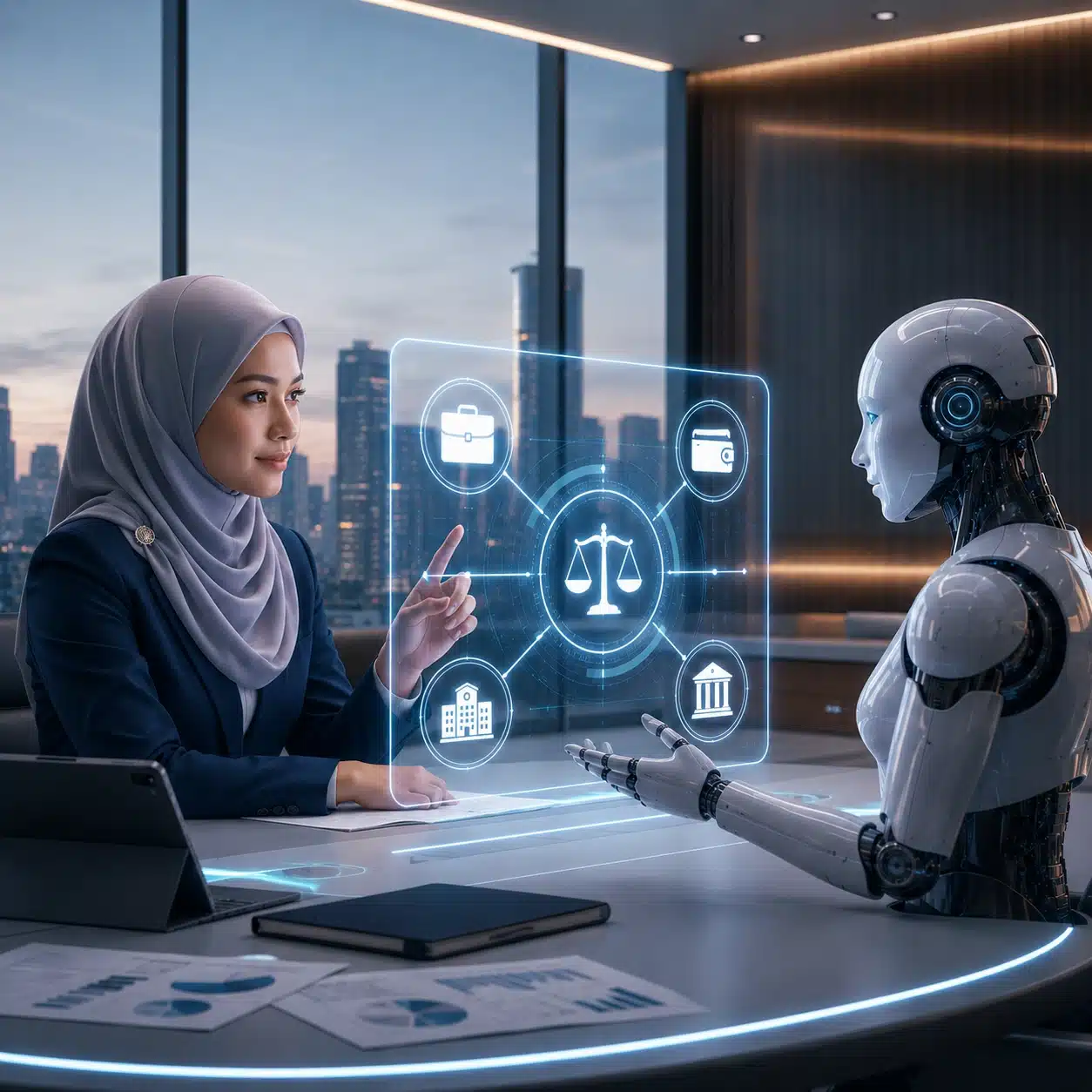
Donald Trump’s revocation of Biden’s AI safety executive order has sent ripples through the tech world, signaling a dramatic shift in the US approach to artificial intelligence. While the US embraces a deregulated “innovate now, ask questions later” approach, where does that leave Malaysia?
Trump’s move, lauded by those who see regulation as a stifle to progress, raises valid concerns. Will a Wild West approach to AI development unleash a torrent of unforeseen consequences? Or will it spark a new era of unprecedented technological advancement?
The emergence of DeepSeek, the Chinese AI chatbot making waves globally, adds another layer of complexity. Developed at a fraction of the cost of its American rivals, DeepSeek demonstrates that innovation doesn’t always require a blank check. It also challenges the US strategy of containing China’s technological rise through chip export restrictions.
Malaysia, with its growing ambitions in the tech sector, must navigate this evolving landscape carefully. While some argue for mirroring the US’s deregulatory approach to attract investment and foster innovation, we must also consider the potential risks. Do we want to be a testing ground for potentially disruptive AI technologies, or should we prioritize a more cautious, ethical approach? Malaysia already has a foundation of ethical guidelines for AI development. We should build upon these, learning from the comprehensive frameworks being developed in Europe, like the General Data Protection Regulation (GDPR) and Artificial Intelligence (AI) Act, rather than following in Trump’s deregulatory footsteps. Regulations, when implemented thoughtfully, don’t necessarily curb innovation. Instead, they can foster a vital balance between technological advancement and the protection of fundamental rights, preventing the potential for privacy violations and other harmful consequences of unchecked AI development.
Perhaps a middle ground is possible. We can encourage responsible AI development by fostering a regulatory environment that balances innovation with safeguards. This means promoting ethical guidelines, data privacy standards, and transparency while avoiding excessive red tape that stifles creativity.
Malaysia can also leverage DeepSeek’s open-source model to build a thriving local AI ecosystem. By empowering our researchers and developers to work with and adapt this technology, we can create innovative solutions tailored to our unique needs and challenges.
Trump’s gamble on deregulation presents both opportunities and risks for Malaysia. We must carefully consider our own path, balancing the potential rewards of rapid AI development with the responsibility of mitigating potential harms. The AI revolution is upon us, and Malaysia needs to choose its role wisely.
© 2025 Suppiah & Partners. All rights reserved. The contents of this newsletter are intended for informational purposes only and do not constitute legal advice.
More Featured Articles

Grounded By Cyber Threats Aviation’s Growing Digital Vulnerabilities
Grounded By Cyber Threats Aviation's Growing Digital Vulnerabilities
by Thulasy Suppiah, Managing Partner
A few weeks ago, Japan Airlines (JAL) suffered a major cyberattack on one of the busiest days to fly – Boxing Day. While the resulting disruptions were temporary, it highlighted yet again the fragility of IT-dependent systems.
Beginning 7.24 am local time, the attack targeted network equipment connecting internal and external systems. This led to both domestic and international flight delays, with the airline’s app, and baggage handling systems also affected. At least 24 domestic flights were delayed by more than 30 minutes.
Whilst the threat was eliminated within a few hours, JAL had to temporarily shut down the affected router and suspended ticket sales for same-day flights resulting in considerable chaos and inconvenience to travelers. The airline later confirmed that the disruption resulted from a Distributed Denial of Service (DDOS) attack — their server was flooded with internet traffic to prevent users from accessing connected online services.
As airport, airline, air navigation and other travel or transport systems embrace digital transformation, including cloud migration, Internet of Things (IoT) integration, and AI-driven automation, its attack surface has expanded significantly. This makes the sector an attractive target for cybercriminals, nation-state actors and hacktivists.
In July last year, an enormous IT outage linked to a faulty CrowdStrike update, disrupted airlines globally, grounding over 10,000 flights and highlighting the industry’s reliance on interconnected digital systems. Though not a cyberattack, it had huge implications on airport systems and flights worldwide.
In June, Indonesia faced one of its worst cyberattacks with more than 40 government agencies impacted, and disrupting operations at major airports.
In 2018, Hong Kong’s national flag carrier, Cathay Pacific Airways admitted to a data breach involving the extensive personal data of some 9.4 million customers. Passengers’ personal information such as passport information including their nationality and date of birth; phone number; credit card information; identity card number; and even historical travel information was exposed.
In another ransomware attack last year, operations at Japan’s largest and busiest terminal port in the city of Nagoya were paralysed – making it unable to load and unload containers for three days. Located just 7 km south of the terminal is Chubu International Airport, an air gateway that operates in coordination with the sea port. The attack on The Nagoya Port Unified Terminal System (NUTS) – such a critical infrastructure in Japan, handling 10 percent of the nation’s trade – highpoints the significant ripple effects such incidents could have on essential services and supply chains not just in Japan but for the global economy.
Skift – an online source for travel news – highlighted an Imperva 2024 Bad Bot Report, which found that the travel industry suffered the second-highest volume of account takeover attempts in 2023. Around 11% of all cyberattacks targeted the sector and Cornelis Jan G, a Senior Cyber Threat and OSINT Analyst, from the Netherlands, says the aviation industry can expect to face an escalation in cyber threats in the next 12 to 24 months.

“State-sponsored groups will continue to target aviation for strategic intelligence and economic espionage, while cybercrime syndicates will increase their focus on ransomware and supply chain attacks,” he wrote in an article (Reference Item 9). He believes the industry will benefit from increased investment in AI-driven threat detection technologies, and a focus on a zero-trust architecture which limits lateral movement within networks. Callie Guenther, a cyber-threat research senior manager at Critical Start, in a comment to Infosecurity Magazine about the Nagoya cyberattack said, organisations need to stay informed about the latest ransomware trends, leverage threat intelligence sources to understand the evolving tactics, techniques, and procedures by ransomware operators, and adjust their security strategies accordingly.
For successful implementation of cyber security in the aviation industry, AI and tech-focused law firms play an imperative role. They provide essential and tailored legal services to navigate the complexities of AI integration.
Boeing for instance relies on its legal team to ensure compliance with strict Federal Aviation Administration (FAA) regulations and safety standards. United Airlines engages legal experts to establish guidelines for its AI applications in customer service, to prevent bias in AI algorithms and to ensure fair customer interactions. They also consult on transparency measures to let customers know how their data is used. Delta Airlines seeks risk management advice for AI predictive maintenance to mitigate potential liability issues related to operational failures.
Airbus engages legal services to negotiate contracts with its software vendors. These contracts are necessary to define the scope of work, data ownership and liability for AI-driven analytics. This is essential for the interests of both the aircraft company and the vendor, and to ensure compliance with aviation regulations.
References
- Nagoya Port faces Disruption after Ransomware Attack
- National Cyber Security: Global IT outage not cyberattack, still caused considerable impact to Malaysia
- Major cyberattack disrupts holiday season flights at Japan Airlines
- Japan Airlines hit by cyberattack, ticket sales for flights departing on Dec. 26, 2024 suspended
- JAL’s systems back to normal after cyberattack delayed flights
- JAL’s system under cyberattack, domestic and int’l flights delayed
- Cyberattack hits Japan Airlines; flights delayed, ticket sales suspended
- Japan Airlines hit by cyberattack, delaying some flights
- Cyber Threat Intelligence Landscape and Actionable Forecast for Aviation Security Teams
- CrowdStrike outage explained: What caused it and what’s next
- CrowdStrike: What the 2024 outage reveals about security
- The Cathay Pacific breach: a lesson in managing data protection risks
- Global standstill: could defensive AI have mitigated the impact on aviation and beyond?
- What is AI security?
- Leveraging AI as a Force Multiplier for Attack Surface Management
- Japan airlines under cyberattack, flights delayed
- Japan Airlines reports cyberattack on system, impacting flights
- Japan links hacker MirrorFace to dozens of cyberattacks targeting security, tech data
- Japan Airlines suffers major cyberattack; flights delayed, ticket sales halted
© 2025 Suppiah & Partners. All rights reserved. The contents of this newsletter are intended for informational purposes only and do not constitute legal advice.
More Newsletter






[Feature Article] Opportunities for Affordable AI Development
Opportunities for Affordable AI Development
Published by The Star on 31 Jan 2025
Published by New Straits Times on 31 Jan 2025: Use DeepSeek model to thrive in AI sector
by Thulasy Suppiah, Managing Partner
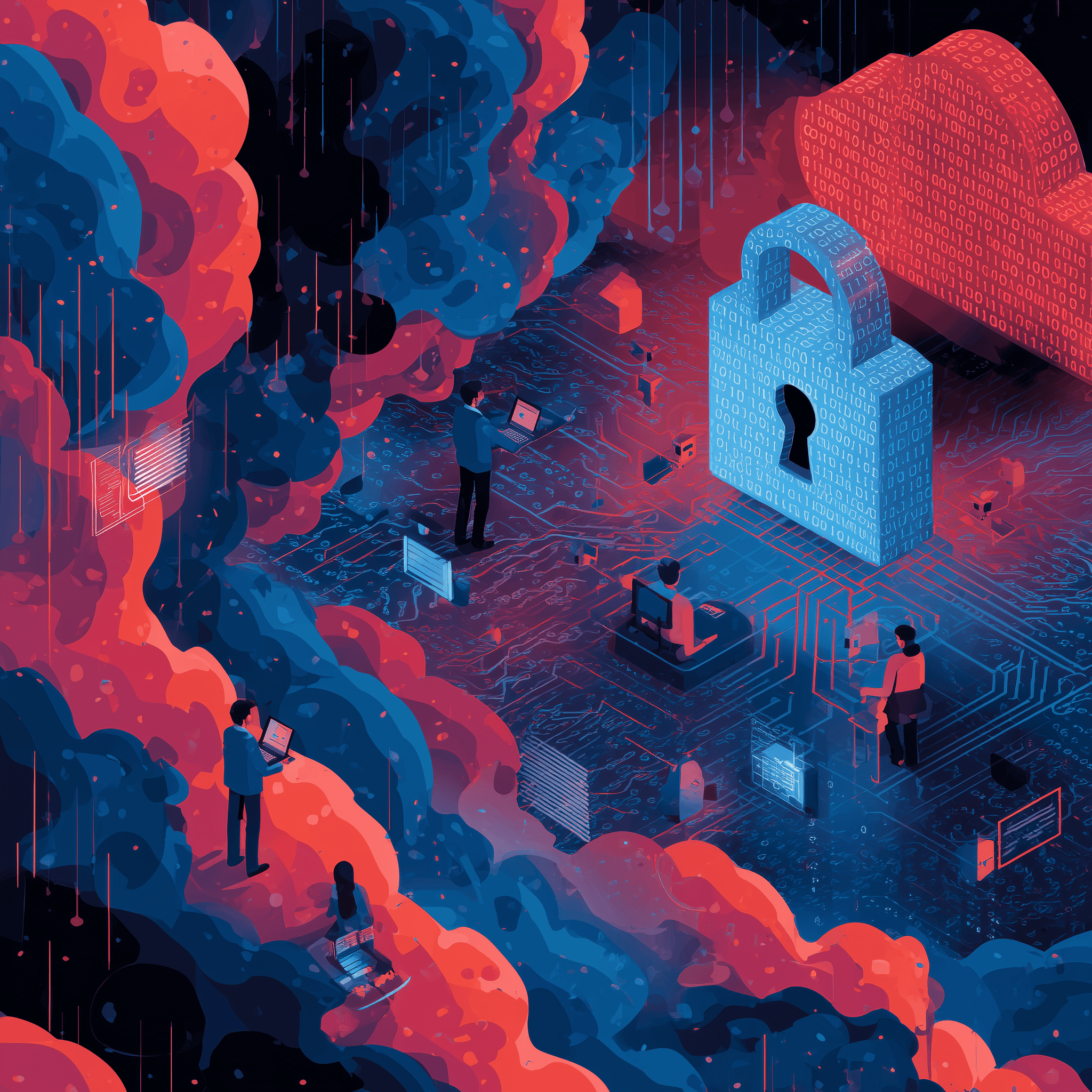
The shockwaves from DeepSeek’s emergence in the AI arena are being felt far beyond Silicon Valley – and they should be. This Chinese-developed chatbot isn’t just another competitor; it’s a wake-up call, and frankly, a bit of a humbling experience for the American tech giants who thought they had the game sewn up. DeepSeek’s success throws a wrench into the US-China AI war and presents both a challenge and an enormous opportunity for nations like ours, looking to carve out a space in this rapidly evolving landscape. It’s a testament to Asian innovation, with China leading the charge and India hot on its heels, fresh from its recent space program triumphs. Looks like the future of tech might not be so Western-centric after all.
One of DeepSeek’s most disruptive features is its cost-effectiveness. Built for a fraction of the price of its American rivals, it undercuts the assumption that massive budgets and top-tier hardware are essential for AI dominance. This has sent shivers down the spines of industry giants like Nvidia, whose stock plummeted after DeepSeek’s release. Perhaps Silicon Valley needs a lesson in frugality?
But beyond the financial implications, DeepSeek challenges the very notion of how we build and access AI. Its open-source nature and low API costs mean practically zero switching costs for users. This accessibility could democratize AI development, shifting power away from large corporations and empowering smaller players.
Where does Malaysia fit into this evolving landscape? We have a unique opportunity to position ourselves as a hub for affordable and accessible AI development. Instead of trying to compete head-on with the giants, we can focus on building a thriving ecosystem that leverages DeepSeek’s open-source model.
Imagine Malaysian startups and researchers building innovative applications on top of DeepSeek, tailored to local needs and languages. Imagine a vibrant community of developers contributing to and refining the model, making AI more inclusive and accessible for all.
This approach requires a shift in mindset. We need to embrace open-source technologies, invest in training and development for our workforce, and create a regulatory environment that fosters innovation and collaboration. We also need to address legitimate concerns about data security and privacy, ensuring responsible AI development.
DeepSeek’s arrival is a wake-up call. The AI landscape is changing rapidly, and Malaysia has a choice: we can be swept aside by the tide, or we can ride the wave and become a leader in this exciting new era.
© 2025 Suppiah & Partners. All rights reserved. The contents of this newsletter are intended for informational purposes only and do not constitute legal advice.
More Featured Articles

Cyber Threats Unmasked: Malaysia’s Legal Safeguards
CYBER THREATS UNMASKED: MALAYSIA'S LEGAL SAFEGUARDS
brought to you by Suppiah & Partners
The cybersecurity landscape continues to evolve with various emerging threats, such as AI-driven cyberattacks and deepfake scams that leverage advanced technologies for malicious purposes.
Organisations must remain vigilant against these evolving threats while adhering to local regulations that govern cybersecurity practices in Malaysia.
DDOS ATTACK
DESCRIPTION
A Distributed Denial-of-Service (DDoS) attack aims to disrupt normal traffic by overwhelming a web property with massive requests from multiple devices (botnet).
CHARACTERISTICS
- Utilizes multiple compromised devices (bots).
- Targets network bandwidth or application resources.
- Does not require access to internal systems.
OPERATIONAL / BUSINESS IMPACT
- Service outages.
- Loss of revenue.
- Damage to reputation.
PREVENTIVE MEASURES / RESPONSES
- Use of DDoS mitigation services.
- Traffic filtering and rate limiting.
- Regular system updates.
LEGAL PROTECTIONS / CONSIDERATIONS IN MALAYSIA
- Governed by the Cyber Security Act 2024, which mandates compliance for NCII sectors.
- Non-compliance can lead to fines up to 500,000 ringgit or imprisonment for up to ten years.
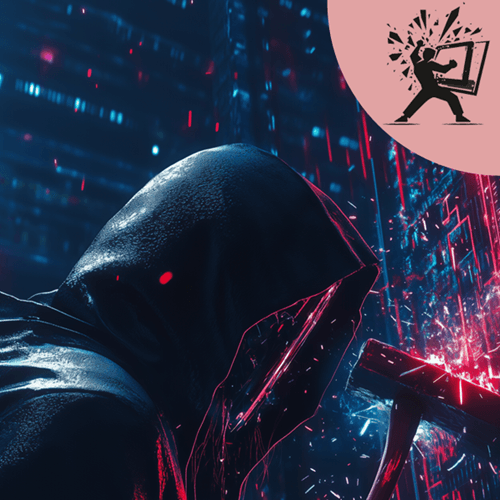
THE HOOLIGAN
Like a hooligan, a DDoS attacker causes chaos and disruption, overwhelming systems and services with no intention of directly stealing but instead creating noise and destruction.
RANSOMWARE ATTACK
DESCRIPTION
Ransomware is malicious software that encrypts files and systems, rendering them inaccessible until a ransom is paid.
CHARACTERISTICS
- Encrypts data and demands payment for decryption.
- Requires access to internal systems, often via phishing.
- Typically demands payment in cryptocurrency.
OPERATIONAL / BUSINESS IMPACT
- Data loss.
- Operational downtime.
- Significant financial costs for recovery and ransom payment.
PREVENTIVE MEASURES / RESPONSES
- Regular backups and disaster recovery plans.
- Employee training on phishing.
- Endpoint protection solutions.
LEGAL PROTECTIONS / CONSIDERATIONS IN MALAYSIA
- Subject to the Cyber Security Act 2024; organizations must notify incidents within six hours.
- Penalties for failing to report can include fines up to 500,000 ringgit or imprisonment for up to ten years.
- Subject to the Computer Crimes Act 1997 penalties (fines, imprisonment) could apply for any unauthorised modification of the contents of any computer.
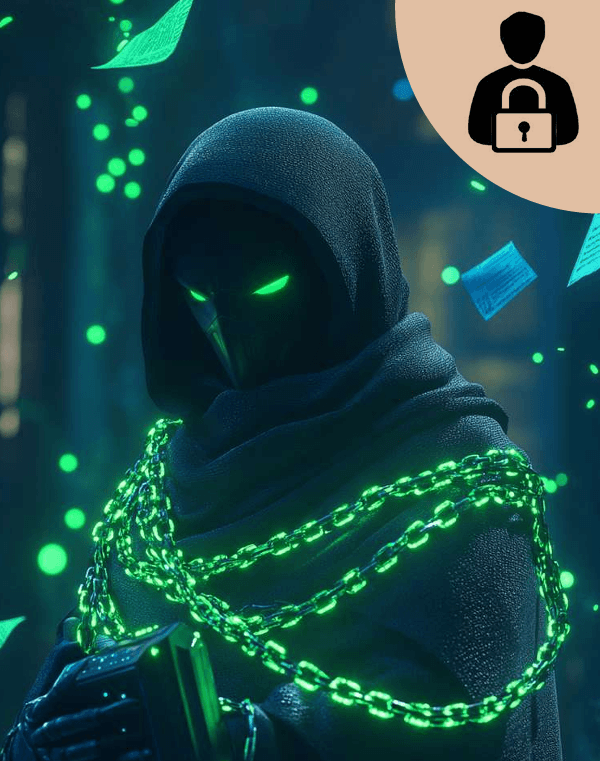
THE KIDNAPPER
Encrypting critical data and demanding ransom mirrors a kidnapper holding a victim hostage for financial gain.
RANSOM DDOS (RDDOS) ATTACK
DESCRIPTION
A Ransom DDoS attack threatens to launch a DDoS attack unless a ransom is paid, without encrypting any data.
CHARACTERISTICS
- Threatens service disruption rather than data encryption.
- May follow an actual DDoS attack or be a threat.
- Payment often requested in untraceable forms like Bitcoin.
OPERATIONAL / BUSINESS IMPACT
- Service disruption without prior notice.
- Potential financial losses from ransom payments.
PREVENTIVE MEASURES / RESPONSES
- Implementing robust network security measures.
- Monitoring traffic patterns for anomalies.
- Having an incident response plan in place.
LEGAL PROTECTIONS / CONSIDERATIONS IN MALAYSIA
- Governed by the Cyber Security Act 2024; compliance with incident reporting is mandatory.
- Legal repercussions for non-compliance include fines and imprisonment.

THE EXTORTIONIST
The RDDoS attacker threatens service disruption unless a ransom is paid, akin to an extortionist intimidating victims without necessarily carrying out their threat.
PHISHING
DESCRIPTION
Phishing involves tricking individuals into providing sensitive information by masquerading as a trustworthy entity.
CHARACTERISTICS
- Often conducted via email or instant messaging.
- Uses deceptive links or attachments.
- Targets personal and financial information.
OPERATIONAL / BUSINESS IMPACT
- Financial loss.
- Identity theft.
- Loss of trust in digital communications.
PREVENTIVE MEASURES / RESPONSES
- User education on recognizing phishing attempts.
- Implementation of email filtering technologies.
- Multi-factor authentication (MFA). Software updates.
LEGAL PROTECTIONS / CONSIDERATIONS IN MALAYSIA
- Governed by the Personal Data Protection Act (PDPA) 2010, which requires organizations to protect personal data. Non-compliance can lead to fines up to RM300,000.
- Subject to Section 17(3) of the Electronic Commerce Act 2006.
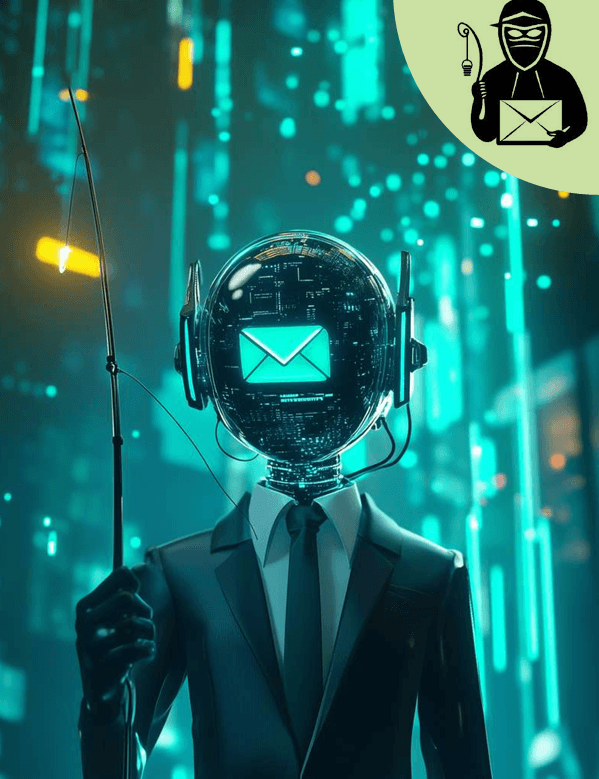
THE CON ARTIST
Phishing attackers rely on deception and impersonation to trick victims into revealing sensitive information, much like a skilled con artist manipulates trust to defraud.
SQL INJECTION
DESCRIPTION
SQL Injection involves inserting malicious SQL queries into input fields to manipulate databases.
CHARACTERISTICS
- Targets web applications with database backends.
- Can extract, modify, or delete data.
- Often due to improper input validation.
OPERATIONAL / BUSINESS IMPACT
- Data breaches.
- Loss of sensitive information.
- Potential legal liabilities.
PREVENTIVE MEASURES / RESPONSES
- Use of prepared statements and parameterized queries.
- Regular security testing and code reviews.
LEGAL PROTECTIONS / CONSIDERATIONS IN MALAYSIA
- Subject to the Computer Crimes Act 1997, which criminalizes unauthorized access and data manipulation. Penalties include fines and imprisonment.
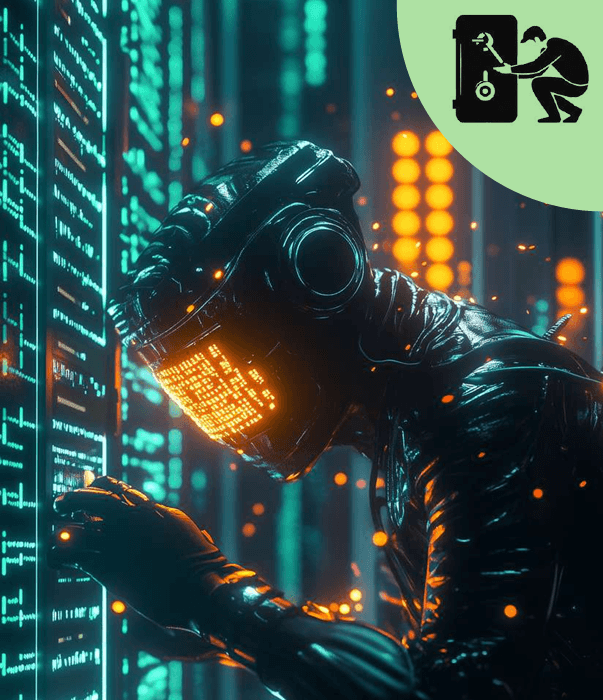
THE SAFECRACKER
Exploiting vulnerabilities in databases to extract, modify, or delete data is akin to a safecracker breaking into a vault to steal valuables.
MAN-IN-THE-MIDDLE (MITM)
DESCRIPTION
MITM attacks involve intercepting communication between two parties without their knowledge.
CHARACTERISTICS
- Can occur over unsecured networks (e.g., public Wi-Fi).
- Often uses spoofing techniques.
OPERATIONAL / BUSINESS IMPACT
- Eavesdropping on sensitive data.
- Data manipulation.
PREVENTIVE MEASURES / RESPONSES
- Use of encryption protocols (e.g., HTTPS).
- VPN usage on public networks.
LEGAL PROTECTIONS / CONSIDERATIONS IN MALAYSIA
- Covered under the Computer Crimes Act 1997; unauthorized interception of communications is illegal. Penalties can include fines and imprisonment.

THE SPY
Intercepting communication and manipulating it without the parties’ knowledge resembles a spy or eavesdropper gathering intelligence secretly.
MALWARE
DESCRIPTION
Malware refers to malicious software designed to harm or exploit any programmable device or network.
CHARACTERISTICS
- Includes viruses, worms, trojans, ransomware, etc.
- Can steal data or damage systems.
OPERATIONAL / BUSINESS IMPACT
- Data loss or corruption.
- System downtime.
PREVENTIVE MEASURES / RESPONSES
- Antivirus software deployment.
- Regular updates and patches.
LEGAL PROTECTIONS / CONSIDERATIONS IN MALAYSIA
- The Cyber Security Act 2024 includes provisions against malware distribution; violators may face penalties including fines and imprisonment.

THE SABOTEUR
Malware acts like a saboteur, infiltrating systems and causing damage, stealing information, or corrupting operations from within.
ZERO-DAY EXPLOIT
DESCRIPTION
A zero-day exploit takes advantage of a previously unknown vulnerability before it is patched by developers.
CHARACTERISTICS
- Highly effective as there are no defenses available at the time of attack.
OPERATIONAL / BUSINESS IMPACT
- Significant risk as exploits can lead to unauthorized access or data breaches.
PREVENTIVE MEASURES / RESPONSES
- Timely software updates and patch management practices.
- The usage of firewalls.
LEGAL PROTECTIONS / CONSIDERATIONS IN MALAYSIA
- Subject to the Computer Crimes Act 1997; exploitation of vulnerabilities can lead to legal consequences including fines and imprisonment.

THE OPPORTUNIST
Exploiting unknown vulnerabilities before they are patched mirrors an opportunist who strikes when their target is unprepared.
SOCIAL ENGINEERING ATTACK
DESCRIPTION
Social engineering involves manipulating individuals into divulging confidential information through deception.
CHARACTERISTICS
- Relies on psychological manipulation rather than technical skills.
OPERATIONAL / BUSINESS IMPACT
- Compromised sensitive information.
- Financial loss.
PREVENTIVE MEASURES / RESPONSES
- User awareness training on social engineering tactics.
- Verification processes for sensitive requests.
LEGAL PROTECTIONS / CONSIDERATIONS IN MALAYSIA
- Covered under various laws including the PDPA; organizations must safeguard personal data against such tactics. Violations may result in legal action and fines.
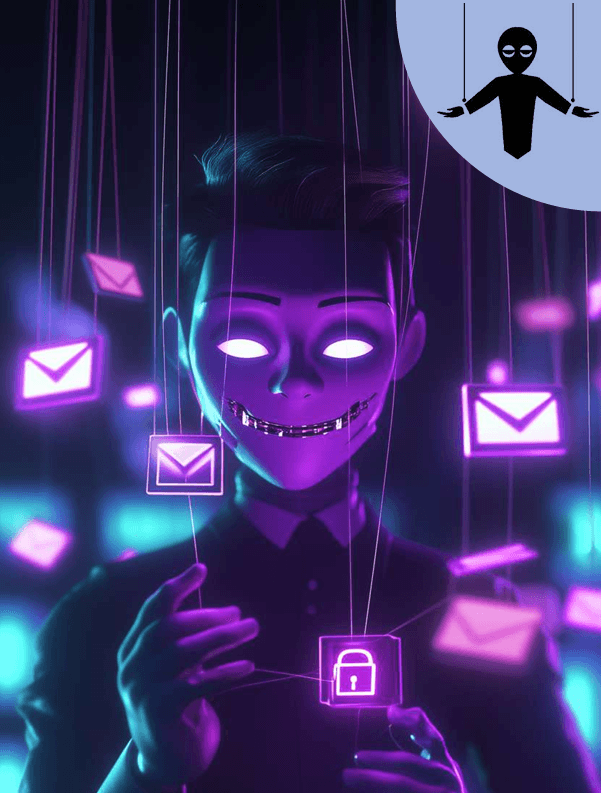
THE MASTER MANIPULATOR
Using psychological tricks to gain sensitive information mimics a manipulator exploiting trust and emotions for their gain.
SUPPLY CHAIN ATTACK
DESCRIPTION
Supply chain attacks target vulnerabilities within third party vendors or partners to compromise an organization indirectly.
CHARACTERISTICS
- Exploits trust relationships between organizations.
- Can affect multiple entities simultaneously.
OPERATIONAL / BUSINESS IMPACT
- Data breaches.
- Operational disruptions.
- Financial losses.
PREVENTIVE MEASURES / RESPONSES
- Thorough vetting of suppliers.
- Continuous monitoring of third-party security practices.
LEGAL PROTECTIONS / CONSIDERATIONS IN MALAYSIA
- Subject to the Cyber Security Act 2024; organizations must ensure third-party compliance with cybersecurity standards, with penalties for non compliance.
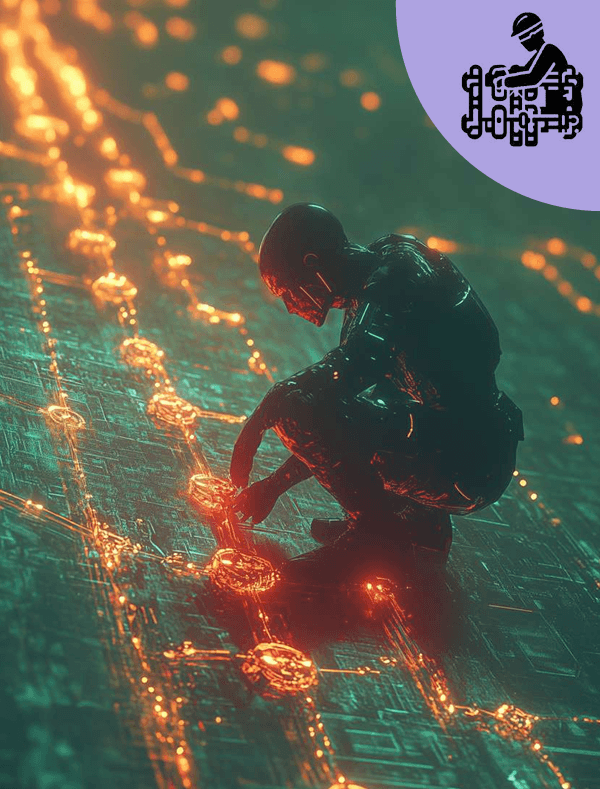
THE SABOTAGE SPECIALIST
Targeting trusted suppliers or partners to indirectly harm an organization is similar to a specialist who infiltrates indirectly to cause systemic harm.
AI-DRIVEN CYBERATTACKS
DESCRIPTION
Cybercriminals use AI tools to automate attacks, create personalized phishing emails, and adapt tactics in real-time.
CHARACTERISTICS
- Highly sophisticated attacks that evade traditional detection methods.
OPERATIONAL / BUSINESS IMPACT
- Increased difficulty in detecting threats.
- Potentially higher success rates for attackers.
- Rapid pace of the attack poses difficulty to effectively respond.
PREVENTIVE MEASURES / RESPONSES
- Invest in advanced AI based detection tools.
- Regularly update security protocols.
LEGAL PROTECTIONS / CONSIDERATIONS IN MALAYSIA
- No specific laws yet; however, general cybersecurity laws apply as AI-driven attacks fall under existing cybercrime regulations.
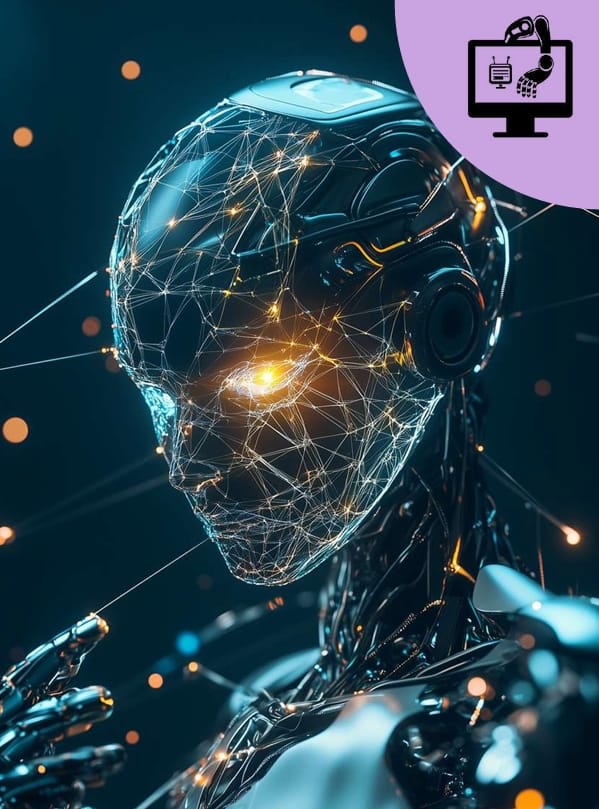
THE HIGH-TECH FRAUDSTER
Leveraging AI for personalized phishing, automation, and real-time adaptability mirrors a high-tech fraudster using advanced tools to outsmart traditional defenses.
DEEPFAKE SCAMS
DESCRIPTION
Deepfake technology creates realistic audio or video impersonations used in scams or social engineering attacks.
CHARACTERISTICS
- Can convincingly impersonate trusted individuals.
- Exploits trust within organizations.
OPERATIONAL / BUSINESS IMPACT
- Financial fraud.
- Compromised sensitive information.
PREVENTIVE MEASURES / RESPONSES
- Employee training on recognizing deepfake content.
- Verification processes for unusual requests.
LEGAL PROTECTIONS / CONSIDERATIONS IN MALAYSIA
- Not specifically regulated; falls under general fraud laws and PDPA if personal data is involved.
- Subject to Section 211(1) of the Communications and Multimedia Act 1998 penalties could apply for content which is indecent, obscene, false, menacing, or offensive in character with intent to annoy, abuse, threaten or harass any person.
THE IMPERSONATOR
Creating realistic fake identities to deceive others resembles an impersonator or forger who mimics others for fraudulent purposes.
References
- Cyber Security Act 2024: This act governs cybersecurity measures in Malaysia, particularly for National Critical Information Infrastructure (NCII) sectors.
- Personal Data Protection Act (PDPA) 2010: Regulates the processing of personal data in commercial transactions in Malaysia.
- Computer Crimes Act 1997: Addresses various computer related offenses including unauthorized access and manipulation of data.
© 2025 Suppiah & Partners. All rights reserved. The contents of this newsletter are intended for informational purposes only and do not constitute legal advice.
More Newsletter

[Feature Article] The Star Newspaper: High Stakes Game in Global Chip Industry
High Stakes Game in Global Chip Industry
Published by The Star on 21 Jan 2025
by Thulasy Suppiah, Managing Partner
Donald Trump’s return to power throws a wildcard into the already volatile global chip war. For Malaysia, a nation deeply embedded in the semiconductor industry, this isn’t just about international trade; it’s about safeguarding our economic future.
Trump’s “America First” rhetoric and escalating tensions with China point to an intensified push for decoupling and reshoring of chip production. While these developments pose challenges, they also present unique opportunities for Malaysia. As global tech giants diversify their supply chains away from China, Malaysia has a chance to position itself not just as a manufacturing hub, but as a strategic partner.
Seizing this opportunity demands more than opening our doors to foreign investment. The National Semiconductor Strategy is a good foundation, but we must prioritize moving up the value chain. Investing in advanced packaging, testing, and even chip design will give us the competitive edge to attract high-value projects.
At the same time, Malaysia needs to tread carefully in its geopolitical strategy. Maintaining strong relationships with both the US and China is essential. Overreliance on one side could leave us exposed in this high-stakes game. Balancing diplomacy with strategic economic policies will be key. Adding to the complexity are the recent last-minute restrictions on AI chip exports imposed by the Biden administration before leaving office. These restrictions, implemented just days before Trump’s inauguration, introduce a tiered licensing system that effectively limits the export of advanced AI chips to certain countries, including China. This move, heavily criticized by industry giants, was seen as a parting shot in the escalating US-China tech war. Some argue that these restrictions, drafted without significant industry input, could backfire, harming US competitiveness and ceding ground to rivals. Will Trump maintain these curbs, tighten them, or scrap them altogether? The uncertainty creates a challenging environment for countries like Malaysia, deeply embedded in the global semiconductor supply chain. Malaysia must prepare for all scenarios by fostering a robust and adaptable semiconductor ecosystem.
This isn’t just a battle over chips; it’s a fight for data dominance. As Malaysia aspires to become a regional data centre hub, aligning this ambition with a strong cybersecurity framework will be critical to protect our national interests.
Trump’s presidency will undoubtedly reshape the global tech landscape. Malaysia has the potential to emerge stronger, but we must be proactive, strategic, and prepared to navigate the uncertainties ahead. The chip war is a gamble, and Malaysia must play its cards wisely.
© 2025 Suppiah & Partners. All rights reserved. The contents of this newsletter are intended for informational purposes only and do not constitute legal advice.
More Featured Articles

Is Your Data Safe? Here’s How to Maximise the Security of Your Business Data Against Ai Driven Privacy Risks
Is Your Data Safe?
HERE’S HOW TO MAXIMISE THE SECURITY OF YOUR BUSINESS DATA AGAINST AI DRIVEN PRIVACY RISKS.
by Thulasy Suppiah, Managing Partner
Data. Big Data. Metadata. These are powerful commodities for modern businesses to thrive and survive. Datasets have become such invaluable assets, they need to be stored somewhere safe. Each year, more and more corporate data is being stored in the cloud – a metaphor for the Internet’s services managed by third parties. Everywhere and in Malaysia, this has surged demand for AI-powered cloud storage solutions and applications to manage, process and protect the growing volume of sensitive data. In this article, we examine how a business can identify the right cloud storage services for robust data protection despite unique challenges spawned by Generative AI (Gen AI). These include the misuse of data and shortage of skills to protect against AI-enabled cybercrime. Without proactive oversight, companies leveraging AI risk exposing customer data and IP rights to unauthorized access or manipulation.
BENEFITS OF SOVEREIGN CLOUD SERVICES
Traditionally, companies used public clouds or cloud computing systems located outside the country to store their data. However, this meant little control or accountability over the use of that data. Heedfully, Malaysia has taken steps to safeguard data sovereignty within our borders by providing ways for locally managed services to offer cloud storing platforms to secure business data from foreign access. Today, organisations can store data either in a private cloud or sovereign cloud, regulated by local laws.
A sovereign cloud is a cloud computing environment which enable’s each organisation’s data to be stored on a system of servers located within their own country. This system is hosted by locally managed services, is required to abide by domestic rules governing data privacy; while having to adopt special security measures for the vicinity of the stored data.
Sovereign cloud providers are an important link with expertise to handle and track the flow of data. They can categorise various types of industry data, whether confidential, public, corporate or personal. Their proximity within the country is said to increase their efficiency tenfold through faster execution speeds and greater network stability. By maintaining valuable data within a country’s borders, sovereign cloud offers a more secure means of data protection.
Recent amendments to Malaysia’s Personal Data Protection Act provide further flexibility and higher protection over stored datasets:
- Biometric Data is now explicitly defined as sensitive personal data
- Data portability rights allow individuals to request the transfer of their data
- Data breach definitions are expanded, increasing accountability for data controllers and processors Mandatory
- Data Protection Officers are required for better oversight
While these amendments are much welcomed, they don’t fully address the risks associated with the growing use of AI systems in data processing, in particular, regarding facial recognition technology. Hopefully in time, our government will fine tune our laws to address gaps.
RISK FACTORS IN LEVERAGING AI TOOLS FOR DATA PROCESSING AND STORAGE
As technology users, we tend to focus on interfaces and tools, but not really the accountability and oversights of their internal functions. Machine learning presents a formidable challenge – who governs it? Who is protecting data being hosted by third parties from misuse and theft and the issues surrounding the accuracy of AI tools?
Malaysia has a multifaceted framework to protect personal data in commercial transactions, govern information security, to ensure network reliability and infrastructure integrity and to safeguard data sovereignty. Malaysia’s cyber security laws include:
The Personal Data Protection Act 2010 (PDPA)
This is the key framework that regulates personal data processing in commercial transactions in Malaysia. It mandates the implementation of practical measures to protect personal data from loss, misuse, modification, unauthorised access, disclosure, alteration, or destruction. Non compliance with the PDPA may result in fines ranging from RM100,000 to RM500,000, imprisonment for one to three years, or both.
Communications and Multimedia Act 1998 (CMA)
This Act regulates the communications and multimedia industry and places a premium on information security and network reliable cybersecurity services. The CMA prohibits:
- Fraudulent or improper use of network facilities
- Possession of counterfeit access devices
- Unauthorised access attempts
- Interception of communications without lawful authority
Cyber Security Act 2024
This Act is designed to safeguard the nation’s critical information infrastructure (CII) against complex cyber threats. A notable feature of the act is its focus on cybersecurity service providers, mandating a licensing regime to ensure only qualified entities are authorised to deliver cyber security services. Offenses under the Act are:
- Failing to conduct required risk assessments and audits
- Not notifying relevant authorities about cybersecurity incidents
- Non-compliance with licensing requirements
- Failure to implement mandated cybersecurity practices
Additionally, the Act holds not just organisations but also their employees and agents accountable, extending liability to individuals responsible for compliance within the entity.
Copyright Act 1987
- This Act protects intellectual property, including digital content, by prohibiting:
- Unauthorised transmissions of copyrighted works over the Internet
- Circumvention of technological protection measures that applied to copyrighted works
- Offering technology or devices that enable such circumvention
Electronic Commerce Act 2006
This Act provides a legal framework for electronic transactions, ensuring the security and reliability of online transactions.

CHOOSING THE RIGHT SOVEREIGN CLOUD PROVIDER
As businesses handover their data to third party services, legal professionals with deep understanding of technology and computing systems, can help your company asses the security controls managed services have in place and how your data is being utilised beyond your ambit.
It is crucial to investigate how closely these managed services comply with local laws, are fully licensed for the services they provide and if their cybersecurity is provided only by qualified entities as mandated by the law.
In Malaysia we have reputable and established providers who offer sovereign cloud services and there are several criteria they should meet. These include full certification and compliance with local laws, able to guarantee the sovereignty of data within local borders, able to ensure data privacy, able to conduct Data Protection Impact Assessments, have the skills to classify data, and offer scalability and flexibility as the need for your organisation’s data evolves. They should also have robust security protocols, are able to respond to security incidents efficiently and promptly and are able to pivot well in case of service disruptions or in executing disaster recovery to ensure data remains secure and accessible even in adverse situations.
Technology lawyers can also advice and oversee the terms and conditions of the Service Level Agreements between your organisation and the cloud provider, to ensure they align with your business’ needs and offer acceptable language for dispute resolutions. They can scrutinise the quality of customer support and response time and the structure and transparency of costs associated with storing your data.
CONCLUSION
The rapid growth of cloud computing and the widespread adoption of AI and cloud technologies presents significant opportunities if well leveraged, but this must be matched with caution and a strong focus on safeguarding personal data and copyrights. Businesses have the obligation to ensure their data practices align with local laws and to receive, send, track and store data safely. As local regulatory landscapes and the challenges of Gen AI continue evolve, legal services with sound understanding of technology, can help your business stay abreast, compliant and safe.
REFERENCE
- Data Privacy in the Age of AI: Are Your Cloud Services Putting You at Risk of Non-Compliance? Innoedge. (October 2024).
- Malaysia’s Cyber Security Act 2024: What Businesses Need to Know. ASEAN BRIEFING, Dezan Shira & Associates. Medina, Ayman Falak. (August 2024).
- Gen AI in Data Security: The Double Edged Sword. CyberMagazine. (August 2024).
- Malaysia Pushes Out Groundbreaking Amendment to Personal Data Protection Act – Impact on Businesses. Squire Patton Boggs. Aw, Charmian and Lai, Brandon. (August 6, 2024).
- What is Data Sovereignty? Oracle Cloud Infrastructure (OCI), Oracle Malaysia. Chen, Michael. (May 2024).
- AI and Cloud Computing top tech risks for firms in 2024 Horizon report. ORX. (April 2024).
- Sovereign Cloud: A Necessity for Protecting Malaysia Enterprises’ Data Sovereignty. Exabytes. Xiao Hui. (October 2023).
- As Malaysia embraces cloud, data sovereignty debate intensifies. Moxie Insights. Henderson, James. (September 2023).
- Glossary: Sovereign Cloud. opendatasoft.com. (Accessed 2024).
© 2025 Suppiah & Partners. All rights reserved. The contents of this newsletter are intended for informational purposes only and do not constitute legal advice.
More Newsletter

[Feature Article] The Star Newspaper: Cyber Threats to Aviation Industry
Cyber Threats to Aviation Industry
Published by The Star on 6 Jan 2025
by Thulasy Suppiah, Managing Partner
The recent cyberattack on Japan Airlines, while quickly resolved, serves as a stark reminder of the increasing vulnerability of the aviation sector. While the airline claims no passenger data was leaked, the disruption highlights a growing threat: our skies are no longer just vulnerable to weather patterns, but also to digital storms.
The aviation industry is a prime target for cybercriminals. From ticketing systems to air traffic control, our planes and airports rely on a complex web of interconnected IT systems. A successful attack can cripple operations, costing airlines millions in lost revenue and leaving passengers stranded. Think holiday travel chaos, but sparking a social media frenzy.
But the financial fallout is just the tip of the iceberg. Data breaches can expose sensitive passenger information, and the potential for a cyberattack to compromise flight control systems is a chilling thought. Imagine a hacker taking control of a plane mid-flight – it’s a scenario straight out of a Hollywood thriller, but the threat is real.
Cyberattacks are becoming increasingly sophisticated. Ransomware, DDoS attacks, and the exploitation of third-party software vulnerabilities, like the CrowdStrike outage in 2024, are just some of the tactics employed. Remember that global IT meltdown that grounded planes, froze bank accounts, and silenced news outlets? That’s the interconnected world we live in, and aviation is right in the crosshairs.
The increasing use of AI and cloud technologies in aviation, while promising greater efficiency, also expands the attack surface. More connected systems mean more entry points for hackers. And it’s not just cybercriminals we need to worry about; nation-state actors and hacktivists also have the aviation industry in their sights.
So, what’s being done to protect our skies? In Malaysia, the Malaysian Aviation Commission (MAVCOM) plays a key role in ensuring aviation security, working with other agencies and stakeholders to improve cybersecurity measures. CyberSecurity Malaysia also plays a crucial role in effectively implementing national cybersecurity strategies and providing expertise to various sectors, including aviation. But is it enough? We need a robust, multi-layered approach that combines strong regulations, cutting-edge security technologies, and constant vigilance. We also need to invest in training and education to ensure our aviation professionals are equipped to handle these evolving threats. The question isn’t if another cyberattack will occur, but when. Let’s hope we’re ready when it does.
© 2025 Suppiah & Partners. All rights reserved. The contents of this newsletter are intended for informational purposes only and do not constitute legal advice.
More Featured Articles

[Feature Article] The Star and The Sun Newspaper: Malaysia’s Data Centre Potential
Malaysia’s Data Centre Potential
Published by The Star on 14 Dec 2024
by Thulasy Suppiah, Managing Partner
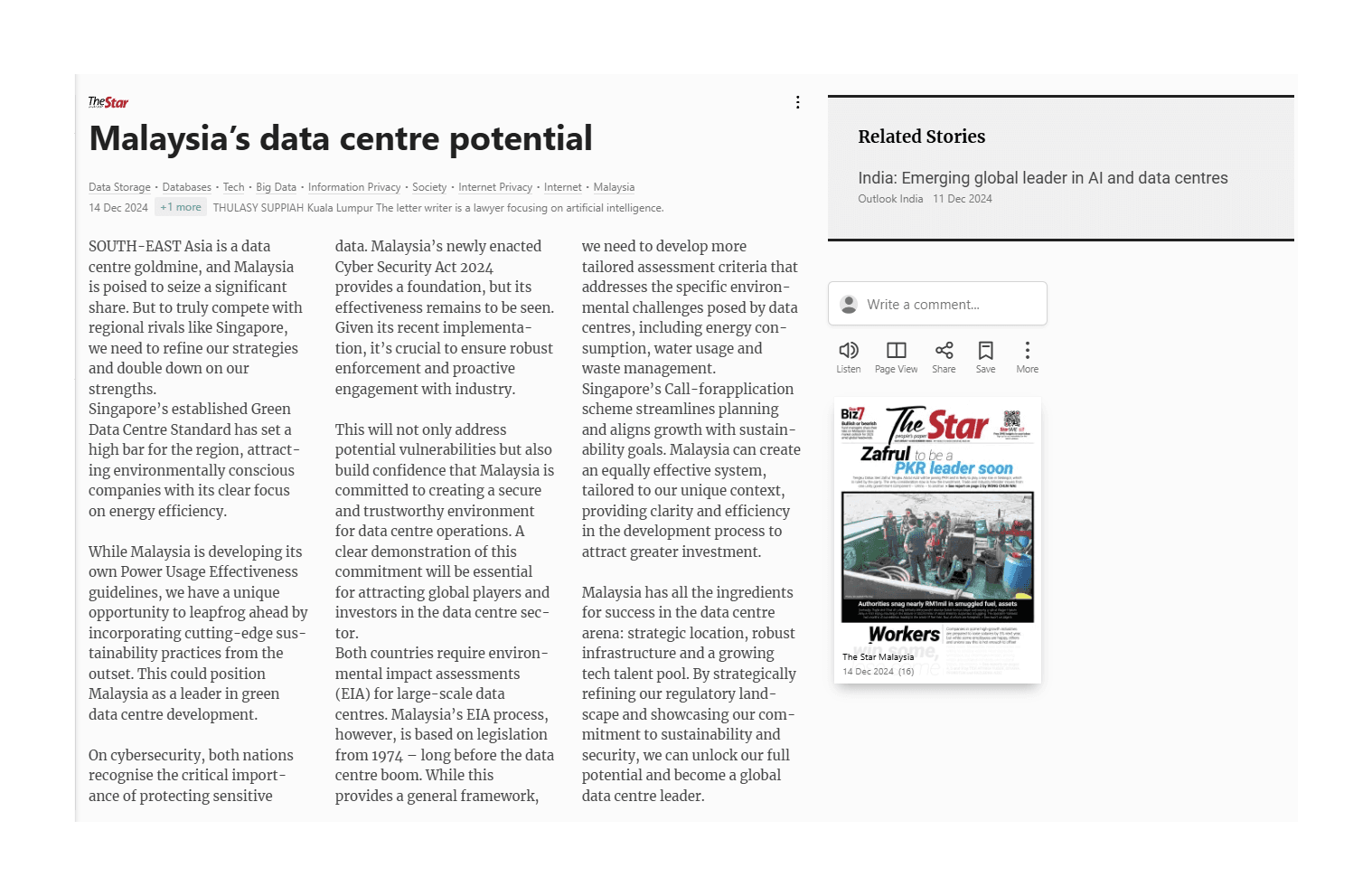
Southeast Asia is a data centre goldmine, and Malaysia is poised to seize a significant share. But to truly compete with regional rivals like Singapore, we need to refine our strategies and double down on our strengths.
Singapore’s established Green Data Centre Standard has set a high bar for the region, attracting environmentally conscious companies with its clear focus on energy efficiency. While Malaysia is developing its own Power Usage Effectiveness guidelines, we have a unique opportunity to leapfrog ahead by incorporating cutting-edge sustainability practices from the outset. This could position Malaysia as a leader in green data centre development.
On cybersecurity, both nations recognize the critical importance of protecting sensitive data. Malaysia’s newly enacted Cyber Security Act 2024 provides a foundation, but its effectiveness remains to be seen. Given its recent implementation, it’s crucial to ensure robust enforcement and proactive engagement with the industry. This will not only address potential vulnerabilities but also build confidence that Malaysia is committed to creating a secure and trustworthy environment for data centre operations. A clear demonstration of this commitment will be essential for attracting global players and investors in the data centre sector.
Both countries require environmental impact assessments for large-scale data centres. Malaysia’s EIA process, however, is based on legislation from 1974 – long before the data centre boom. While this provides a general framework, we need to develop more tailored assessment criteria that address the specific environmental challenges posed by data centres, including energy consumption, water usage, and waste management.
Singapore’s Call-for-Application scheme streamlines planning and aligns growth with sustainability goals. Malaysia can create an equally effective system, tailored to our unique context, providing clarity and efficiency in the development process to attract greater investment.
Malaysia has all the ingredients for success in the data centre arena: strategic location, robust infrastructure, and a growing tech talent pool. By strategically refining our regulatory landscape and showcasing our commitment to sustainability and security, we can unlock our full potential and become a global data centre leader.
© 2025 Suppiah & Partners. All rights reserved. The contents of this newsletter are intended for informational purposes only and do not constitute legal advice.
More Featured Articles
![[Media Feature] The Star: Keeping AI in Check](https://suppiahlaw.com/wp-content/uploads/2026/07/Keeping-AI-in-check-1024x1024.webp)
![[Media Feature] The Star: Safeguards Needed for CCTV Data](https://suppiahlaw.com/wp-content/uploads/2026/06/batch_Thumbnail-1024x1024.webp)
![[Media Features] The Star: Scam Victim’s Successful Bid Sets Precedent for Banks](https://suppiahlaw.com/wp-content/uploads/2026/05/batch_Thumbnail-3-1024x1024.webp)
![[Feature Article] The Star Newspaper: Banks Must Rethink Fraud Controls as AI Risks Rise](https://suppiahlaw.com/wp-content/uploads/2026/05/batch_Thumbnail-4-1024x1024.webp)
![[Feature Article] The Star Newspaper: AI Adoption Cannot Justify Dismissal](https://suppiahlaw.com/wp-content/uploads/2026/05/AI-adoption-cannot-justify-dismissal_thumbnail-1024x1024.webp)
![[Feature Article] The Star & The Sun Newspaper: A Balanced Blueprint For Youth Online Safety](https://suppiahlaw.com/wp-content/uploads/2026/05/Thumbnail-Blueprint-for-youth-online-safety-1024x1024.webp)

Comparative Analysis of Data Center Development Guidelines: Singapore Vs. Malaysia
A Comparative Look: Data Centre Development in Singapore & Malaysia
by Thulasy Suppiah, Managing Partner
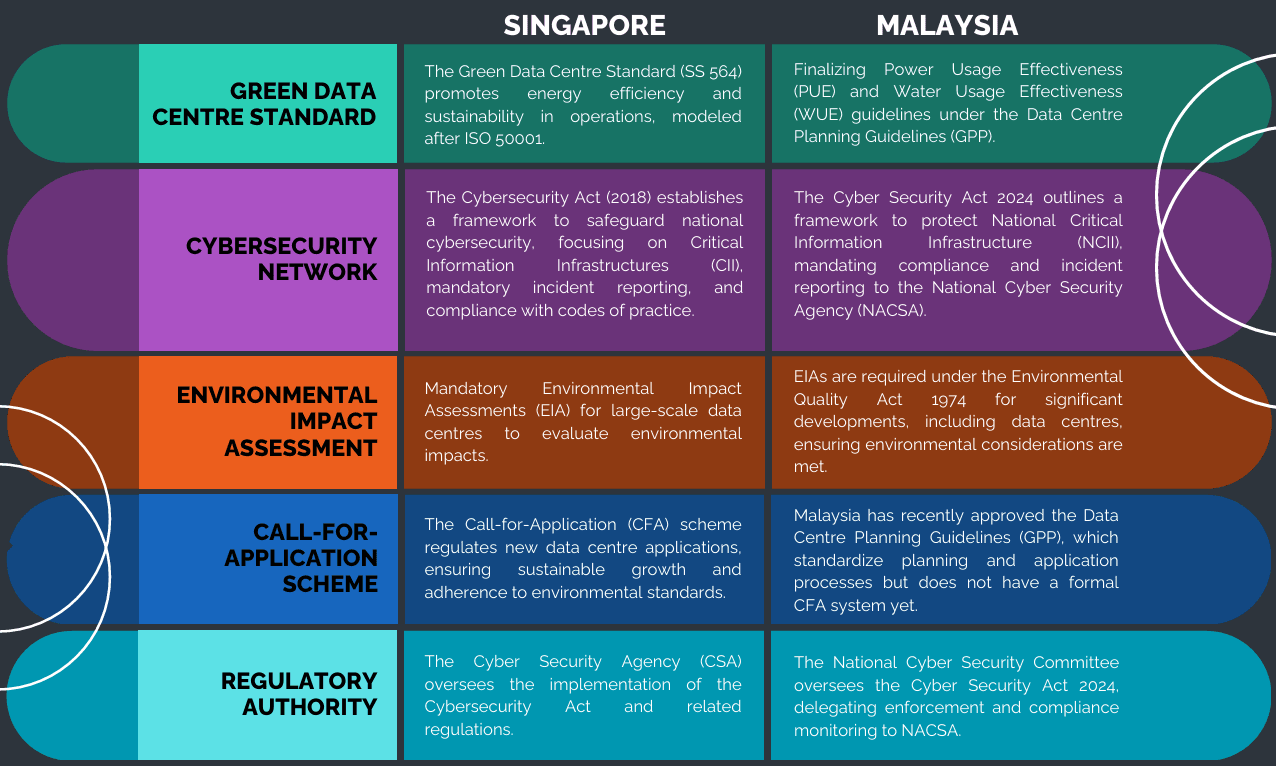
We’ve compared the regulations driving data centre growth in both nations, focusing on sustainability, cybersecurity, environmental assessments, and regulatory processes. As frameworks evolve, these insights are crucial for industry stakeholders.
A SUMMARY: WHERE DO WE STAND AS A NATION?
Malaysia is progressing with balanced growth and sustainability-focused frameworks, but Singapore remains ahead with advanced standards and established regulatory clarity.
GREEN DATA CENTRE STANDARD
Malaysia is progressing with balanced growth and sustainability-focused frameworks, but Singapore remains ahead with advanced standards and established regulatory clarity.
CYBERSECURITY NETWORK
Both countries have robust cybersecurity frameworks; however, Malaysia’s act is newly implemented and lacks established legal precedents, which may lead to challenges in enforcement and interpretation.
ENVIRONMENTAL IMPACT ASSESSMENT
Both countries have robust cybersecurity frameworks; however, Malaysia’s act is newly implemented and lacks established legal precedents, which may lead to challenges in enforcement and interpretation.
CALL-FOR APPLICATION SCHEME
Singapore’s CFA scheme ensures alignment with sustainability goals; Malaysia’s GPP streamlines planning but lacks an equivalent CFA mechanism, which may hinder effective oversight of new developments.
REGULATORY AUTHORITY
Singapore’s CSA has established authority with experience; Malaysia’s National Cyber Security Committee is newly formed, which may face initial challenges in establishing its effectiveness and authority.
© 2025 Suppiah & Partners. All rights reserved. The contents of this newsletter are intended for informational purposes only and do not constitute legal advice.