
When the Cloud is Threatened by Drought
by Thulasy Suppiah, Managing Partner

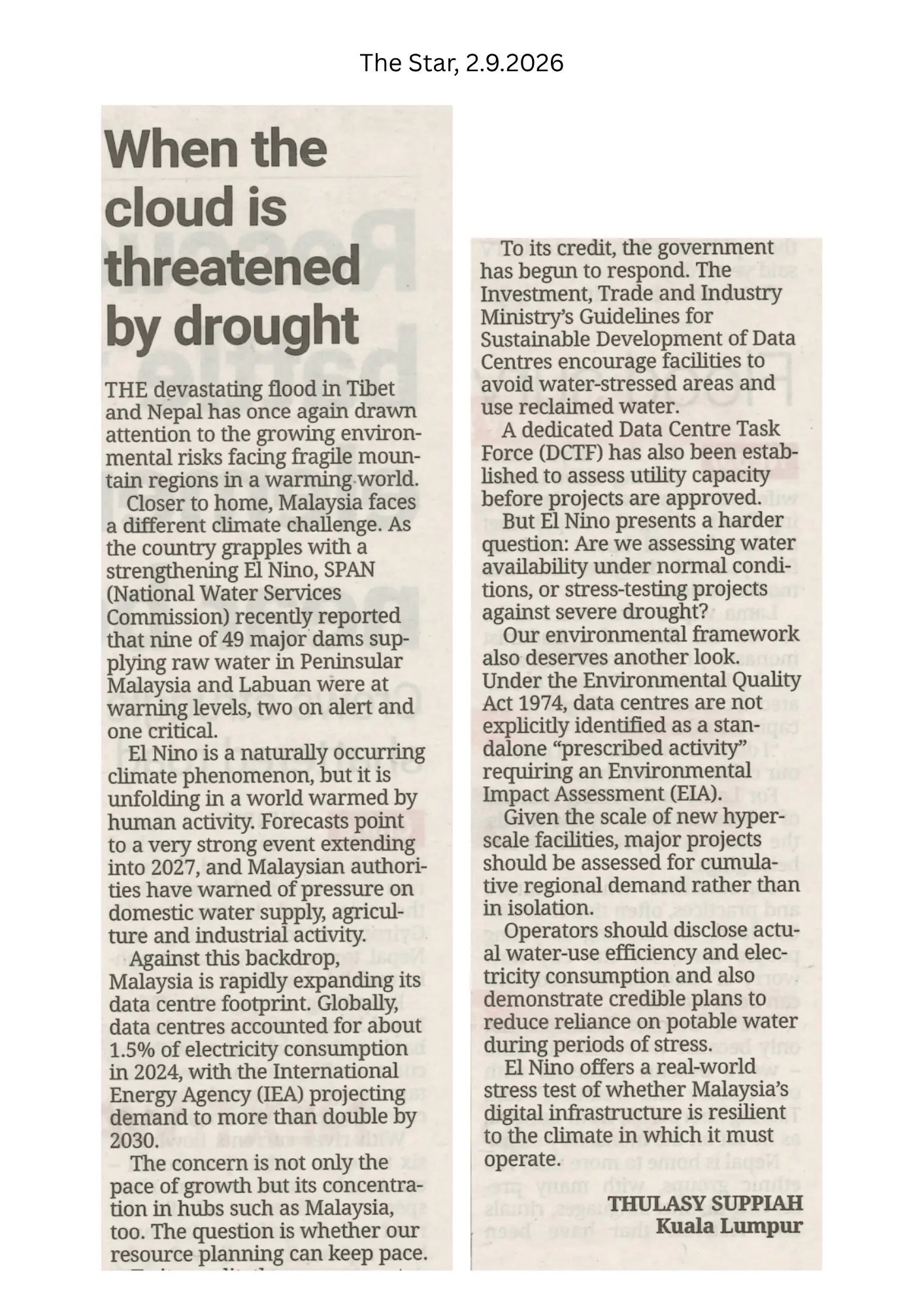
THE devastating flood in Tibet and Nepal has once again drawn attention to the growing environ-mental risks facing fragile moun-tain regions in a warming world.
Closer to home, Malaysia faces a different climate challenge. As the country grapples with a strengthening El Nino, SPAN (National Water Services Commission) recently reported that nine of 49 major dams sup-plying raw water in Peninsular Malaysia and Labuan were at warning levels, two on alert and one critical.
El Nino is a naturally occurring climate phenomenon, but it is unfolding in a world warmed by human activity. Forecasts point to a very strong event extending into 2027, and Malaysian authori-ties have warned of pressure on domestic water supply, agricul ture and industrial activity.
Against this backdrop, Malaysia is rapidly expanding its data centre footprint. Globally, data centres accounted for about 1.5% of electricity consumption in 2024, with the International Energy Agency (IEA) projecting demand to more than double by 2030.
The concern is not only the pace of growth but its concentra-tion in hubs such as Malaysia, too. The question is whether our resource planning can keep pace.
To its credit, the government has begun to respond. The Investment, Trade and Industry Ministry’s Guidelines for Sustainable Development of Data Centres encourage facilities to avoid water-stressed areas and use reclaimed water.
A dedicated Data Centre Task Force (DCTF) has also been estab-lished to assess utility capacity before projects are approved.
But El Nino presents a harder question: Are we assessing water availability under normal condi-tions, or stress-testing projects against severe drought?
Our environmental framework also deserves another look. Under the Environmental Quality Act 1974, data centres are not explicitly identified as a stan-dalone “prescribed activity” requiring an Environmental Impact Assessment (EIA).
Given the scale of new hyper-scale facilities, major projects should be assessed for cumula-tive regional demand rather than in isolation.
Operators should disclose actu-al water-use efficiency and electricity consumption and also demonstrate credible plans to reduce reliance on potable water during periods of stress.
El Nino offers a real-world stress test of whether Malaysia’s digital infrastructure is resilient to the climate in which it must operate.
Written By:
Thulasy Suppiah,
Managing Partner,
Suppiah & Partners,
UG-13, Lexa Galleria, 45, Jalan 34/26,
Wangsa Maju, 53300 Kuala Lumpur.
Handphone no: 012-4915238
© 2026 Suppiah & Partners. All rights reserved. The contents of this newsletter are intended for informational purposes only and do not constitute legal advice.
More Featured Articles






REACH US
SUPPIAH & PARTNERS
(Formerly Law Office of Suppiah)
NAVIGATION
ARTICLES
- COPYRIGHT © 2026 SUPPIAH & PARTNERS ALL RIGHTS RESERVED
- HTML SITEMAP
- PRIVACY POLICY